Mastering QAR: A Guide to Answering Textual Questions Effectively
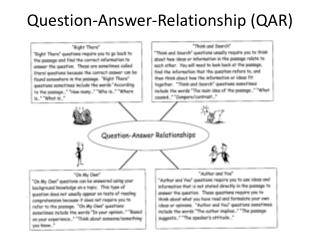
Learn how to navigate through questions using the QAR (Question-Answer Relationship) method. Discover when to "Go," "Stop," or "Take a Turn" when encountering different types of questions. Right There questions involve simple facts and can be answered quickly by scanning the text. Think and Search questions require information from multiple parts of the text, prompting a thoughtful approach. Author and Me questions combine the text with your own experiences, while On My Own asks for your opinions. Enhance your comprehension skills with QAR!

Mastering QAR: A Guide to Answering Textual Questions Effectively
E N D
Presentation Transcript
QARQuestion, Answer Relationship When answering questions, QAR helps you know • when to GO, • when to STOP, • and when to TAKE A TURN.
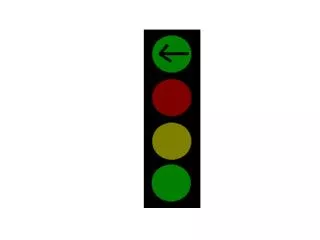
Right There questions ask for simple facts from the text. Right There (green light): Go to the answer by scanning the text to find the key word.
Think and Search questions need information from several parts of the text. Think and Search (yellow light): Slow down. Look around.The answer comes from several places in the text.
Author and Me questions combine text information with reader experience.
On My Own questions ask for the reader’s ideas. On My Own (turning arrow): This is the reader's turn to express an opinion.
Use QAR when answering questions about a text. On My Own (turning arrow): This is the reader's turn to express an opinion. Author and Me (Red light): Stop and put together something the author has told you with something you already know. Think and Search (yellow light): Slow down. Look around.The answer comes from several places in the text. Right There (green light): Go to the answer by scanning the text to find the key word.