Settling Velocity and Mixing Dynamics in Water Treatment Processes
This document explores the settling velocity of solid spherical particles, with a diameter of 0.30 µm and a density of 1,950 kg/m³, in a liquid phase with a density of 1,100 kg/m³ and viscosity of 3.5 cP. It includes calculations for the Reynolds number (NRe) and provides a formula for particle velocity. Additionally, it discusses ideal mixing conditions in water treatment, comparing completely mixed units and plug-flow basins, as well as first-order reaction kinetics in steady-state conditions.

Settling Velocity and Mixing Dynamics in Water Treatment Processes
E N D
Presentation Transcript
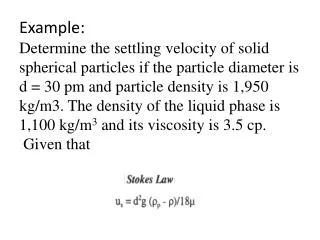
Example:Determine the settling velocity of solid spherical particles if the particle diameter is d = 30 pm and particle density is 1,950 kg/m3. The density of the liquid phase is 1,100 kg/m3 and its viscosity is 3.5 cp. Given that
Water processing Mixing and flocculation Chemical reactors in water treatment are designed as either completely mixed or plug flow basins
1.1. Ideal completely mixed unit • The influent is immediately dispersed through out the volume, and the concentration of reagent in the effluent is equal to that in the mixing liquid. • for steady state conditions the first order reaction kinetics are given by • t=