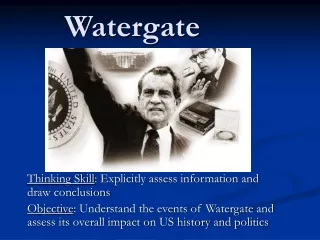
Watergate: Nixon's Political Maneuvers and the Scandal that Shook America
This chapter delves into President Nixon's aggressive campaign strategies during the 1972 election and the ensuing Watergate scandal. Determined to secure re-election, Nixon's administration created an "Enemies List" of political adversaries and employed questionable tactics, including wiretapping and covert operations. The exposure of the Watergate break-in and subsequent cover-up led to a major political scandal. The actions of Nixon and his aides significantly eroded public trust in the government and culminated in Nixon's resignation, marking a pivotal moment in American political history.

Watergate: Nixon's Political Maneuvers and the Scandal that Shook America
E N D
Presentation Transcript
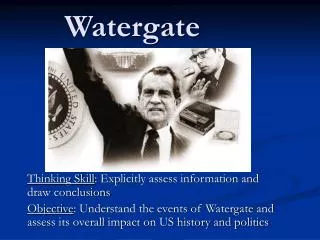
Chapter 25 - Watergate Section 3 – p.838-844
Battling Political Enemies • Nixon was determine to win reelection BIG (1972 Presidential election) • The “Enemies” List • Nixon’s suspicious and secretive nature made the Whitehouse run like it was under attack from political enemies • Aids (Charles Colson, et.al.) created a list of prominent people who were unsympathetic to Nixon’s administration • E. Kennedy, S. Jackson, D. Gregory, J. Fonda, S. McQueen, etc • A plan to disrupt these people was drawn up • Wiretaps • While Nixon ran on law and order, he ordered his followers to wiretap members of his own staff to see if/who was leaking information to the press • Aides took this farther and wiretapped reporters and people on the list • The “Plumbers” • After the Pentagon Papers were leaked, Nixon assigned a group of aides to find and FIX the leaks, called the “Plumbers” • They found out Ellsberg leaked info, their goal then was to punish him
Nixon’s Reelection Campaign • John Mitchell – Committee to Reelect the President (CREEP) • Special Fundraising created a “Slush Fund” to fund legal and illegal reelection activities • HUGE amounts of money were raised before a new law made it illegal to raise money that way • Edwin Muskie • The frontrunner was Edwin Muskie (democrat to run against Nixon in 1972) • Stole letterhead, sent a discrediting letter and leaked it to a newspaper • Letter made bad remarks about the French Canadians living in his state and claimed Muskie’s wife was an alcoholic. • Muskie when on TV to refute the letter, broke down on camera • “Dirty Tricks • Other methods used to disrupt the Democratic candidates • Hecklers sent to campaign stops • Spies sent to work in Democratic offices • Spies sent to work in campaign offices of contenders
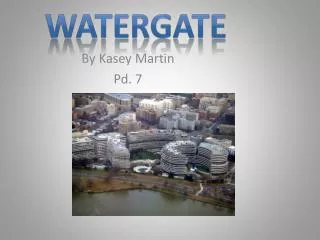
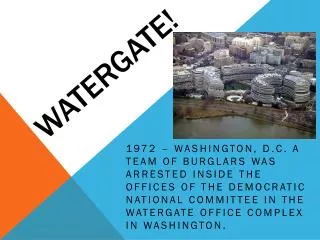
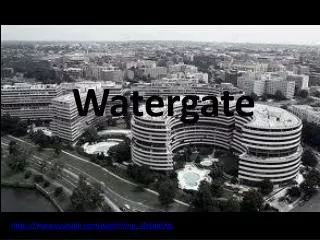
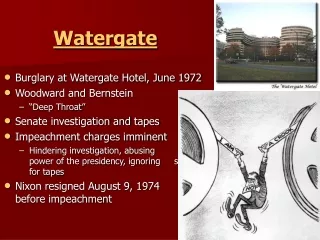
The Watergate Break-In • Within CREEP, a group formed to gather intelligence • Plan to wiretap most of the campaigns was rejected, too expensive • Plan to wiretap Democratic National Headquarters in DC • Watergate Hotel was the DNC headquarters • Break-in on June 17, 1972 was discovered (duct tape on basement door) • Those arrested had money that could be traced back to CREEP • Nixon contacted the CIA to get them to intervene and stop the FBI from investigating • The Cover-up became known as the Watergate Scandal • Nixon was not involved in the planning or break-in but he was in on the cover-up • Incident barely noticed by US public, Nixon would crush McGovern in ‘72 election • 2 reporters, Woodward and Bernstein of the Washington Post, dug and dug, following the money until it could be connected with CREEP • CREEP paid out hundreds of thousands in “hush” money to Watergate defendants, coached them to commit perjury to protect the President
The Scandal Unfolds • Nixon went on TV • “No one in the White House staff was involved in this very bizarre incident.” • Judge John Sirica did not believe the defendants • LONG sentences to convince them to tell truth (up to 40 years) or they could cooperate for shorter sentences • Woodward and Bernstein • Young and eager reporters from the Washington Post dug into the case • Learned about secret funds raised by Mitchell • The Senate Investigation • 1973- Senate Investigative Committee began their hearings • James McCord agreed to cooperate for a shorter sentence • Outlined the basic of how/what CREEP had been up to • To protect himself, Nixon forced the top 2 aides to quit (Haldeman and Ehrlichman) • Nixon went on TV and claimed he had cleaned out those responsible
The Scandal Unfolds • John Dean testified that Nixon knew of the cover-up and that other White House staffers had done illegal things • Alexander Butterfield testified of a secret taping system in the Oval Office (recording all of Nixon’s conversations and phone calls) • Nixon, trying to show his openness, appointed Archibald Cox to investigate the secret tapes. Cox ordered the tapes released, Nixon refused, Cox persisted and Nixon fired him. • Calls for Nixon to resign or be impeached began. • Leon Jaworski replaced Cox and also ordered the tapes released • Nixon released transcripts, Jaworski demanded the actual tapes • Hearing began to determine if the Congress should impeach Nixon • Voted that there was enough evidence to impeach Nixon on obstruction of justice, abuse of power and refuse to obey a congressional order
Nixon Resigns • On August 5, Nixon finally obeyed the order and turned over the tapes. . . With 18 ½ minutes erased • Still the tapes gave undeniable evidence that Nixon was in on the cover-up • On August 8, Nixon appeared on TV and resigned • Gerald Ford became president • The Watergate Scandal is one of the low points in US history • Government had abused its power • Several Nixon aides will go to prison • Most Americans lost faith in the government • But, the strength of the Constitutional system we have was shown to work. . . • When abuse of power came to light, the problem was investigated and dealt with • On the day Ford took office, he was quoted as saying, “Our Constitution works. Our great republic is a government of laws, not of men.”