Matrix Operations in Computer Vision
Learn about matrix operations, determinants, inverses, ranks, eigenvalues, and diagonalization in Computer Vision applications. Explore the properties and definitions of matrices.


Matrix Operations in Computer Vision
E N D
Presentation Transcript
Matrices CS485/685 Computer Vision Dr. George Bebis
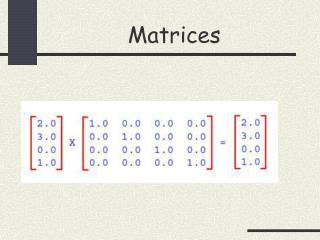
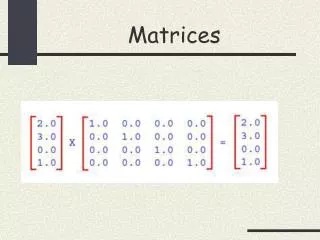
Matrix Operations • Matrix addition/subtraction • Matrices must be of same size. • Matrix multiplication m x n q x p m x p Condition: n = q
Symmetric Matrices Example:
Determinants 2 x 2 3 x 3 n x n
Determinants (cont’d) diagonal matrix:
Matrix Inverse • The inverse A-1 of a matrix A has the property: AA-1=A-1A=I • A-1 exists only if • Terminology • Singular matrix:A-1does not exist • Ill-conditioned matrix: A is close to being singular
Matrix Inverse (cont’d) • Properties of the inverse:
Pseudo-inverse • The pseudo-inverse A+ of a matrix A (could be non-square, e.g., m x n) is given by: • It can be shown that:
Matrix trace properties:
Rank of matrix • Equal to the dimension of the largest square sub-matrix of A that has a non-zero determinant. Example: has rank 3
Rank of matrix (cont’d) • Alternative definition: the maximum number of linearly independent columns (or rows) of A. Therefore, rank is not 4 ! Example:
Orthogonal matrices • Notation: • A is orthogonal if: Example:
Orthonormal matrices • A is orthonormal if: • Note that if A is orthonormal, it easy to find its inverse: Property:
Eigenvalues and Eigenvectors • The vector vis an eigenvector of matrix A and λ is an eigenvalue of A if: • Interpretation: the linear transformation implied by A cannot change the direction of the eigenvectors v, only their magnitude. (assume non-zero v)
Computing λ and v • To find the eigenvalues λ of a matrix A, find the roots of the characteristic polynomial: Example:
Properties • Eigenvalues and eigenvectors are only defined for square matrices (i.e., m = n) • Eigenvectors are not unique (e.g., if v is an eigenvector, so is kv) • Suppose λ1, λ2, ..., λnare the eigenvalues of A, then:
Properties (cont’d) xTAx > 0 for every
Matrix diagonalization • Given A, find P such thatP-1APis diagonal (i.e., P diagonalizes A) • Take P = [v1v2 . . . vn], where v1,v2 ,. . . vnare the eigenvectors of A:
Matrix diagonalization (cont’d) Example:
Are all n x n matrices diagonalizable? • Only if P-1 exists (i.e., A must have n linearly independent eigenvectors, that is, rank(A)=n) • If A has n distinct eigenvalues λ1, λ2, ..., λn, then the corresponding eigevectors v1,v2 ,. . . vnform a basis: (1) linearly independent (2) span Rn
Diagonalization Decomposition • Let us assume that A is diagonalizable, then:
A=PDPT= Decomposition: symmetric matrices • The eigenvalues of symmetric matrices are all real. • The eigenvectors corresponding to distinct eigenvalues are orthogonal. P-1=PT
![[MATRICES ]](https://cdn4.slideserve.com/144276/matrices-dt.jpg)