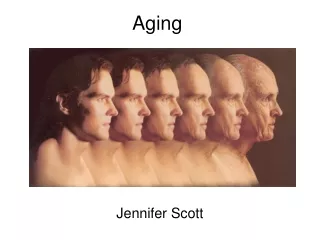
Aging
Aging. Jennifer Scott. What is aging?. The process of growing old General decline in physical and possibly mental functioning Aging and public health. What can aging affect?. Hearing Fat/muscle proportion Water in the body Kidneys Digestion Muscle strength Coordination Taste Smell

Aging
E N D
Presentation Transcript
Aging Jennifer Scott
What is aging? • The process of growing old • General decline in physical and possibly mental functioning • Aging and public health
What can aging affect? • Hearing • Fat/muscle proportion • Water in the body • Kidneys • Digestion • Muscle strength • Coordination • Taste • Smell • Vision • Sexual hormones and sexual functioning • Liver • Cardiovascular system • Respiratory system • Nervous system • Bone strength, density • Hormone levels • Vitamin D levels
Causes of aging • Theories • Aging clock theory • Genetic theory • Connective tissue/cross-linking theory • Free radical theory • Immunological theory
What to do about aging? • Diagnosis • Treatment • Results
Prevention of Aging • Healthy diet • Exercise • Lifestyle habits • Drinking fluids
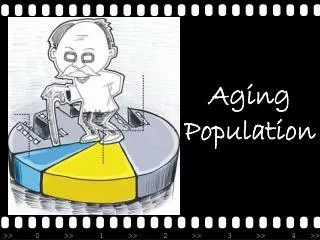
The aging population in the United States • In 2008, there were 38.9 million residents age 65 and over • Life expectancy • Men at 65 years: 17.6 years • Women at 65 years: 20.3 years • Health status • 24% of noninstitutionaled persons age 65 and over in fair or poor health • 7% of noninstitutionalized persons age 65 and over need help with personal care from other persons Every day, 10,000 Americans turn 65 years old
Life expectancy, 2007 Life expectancy at 65 years: 18.6 years Life expectancy at 75 years: 11.7 years
Aging- Health care utilization • 289.7 million ambulatory care visits by persons age 65 and over • 13.9 million discharges from hospitals • 5.7 days average stay in hospitals
Virginia Report Card Upper third Middle third Lower third
The King’s Fund • Model of acute care is unsuited • Lack of social and professional status • Poor working conditions • Failure to keep pace
Care for the aging • 1.3 million nursing home residents • 1 million patients with home health care • 868,100 hospice care discharges • 60% had dental visit
Aging and Mental Health Main message: Depression is not a normal part of growing older • Older adults are at an increased risk for depression • Older adults are often misdiagnosed and undertreated • Estimates of major depression range from less than 1% to 13.5%
Caregiving • What is caregiving? • The cost of being a family caregiver
Advance Care Planning • What is Advace Care planning? • Why is it necessary?
Emergency Preparedness for the Aging • Vulnerable population • Planning • Back ups!
Premature Aging • Laminopathy • Progeria/ Hutchinson-Gilford Progeria Syndrome • Incidence = 1 in 4 million births • Currently, between 35-45 known cases
Total spending • $486 billion for Medicare in 2011
Medicare, continued • The Medicare population • Cost of Medicare • Affordable Care Act
Translational research CDC • Healthy Aging Program • Prevention Research Centers Healthy Aging Research Network (HAN) • Implement interventions that promote good health in older adults • Provide community decision-makers with useful information and resources • Develop practical and effective tools for assessing and evaluating programs and policies • Summarize and disseminate findings to colleagues across multiple sectors and communities • Mentor and train public health practitioners • Inform research priorities • Provide access to experts in healthy aging
Translational research: National Institute on Aging • National Institute of Health: National Institute on Aging • Division of Aging Biology • Division of Behavioral and Social Research • Division of Geriatrics and Clinical Gerontology • Division of Neuroscience
Additional research • Buck Institute for Research on Aging • UC San Diego Stein Institute for Research on Aging • Tufts University Human Nutrition Research Center on Aging • American Federation for Aging Research (AFAR) • The Ellison Medical Foundation • Retirement Research Foundation
The CR Society • Calorie restriction • Men = 1,800, rather than 2,500 • Women = 1,500, rather than 2,000 • History- rats at Cornell at 1934 • Medical improvements • Research
Methuselah Foundation • Mprize • NewOrgan prize • SENS
TED talks- Aubrey de Grey on avoiding aging • http://www.ted.com/talks/aubrey_de_grey_says_we_can_avoid_aging.html