Robust Feature-Based Alignment for Large-Scale Image Matching and Transformation
370 likes | 478 Vues
Robust feature-based alignment techniques are essential for accurately aligning images without pre-existing correspondences. The process involves extracting features, computing putative matches, hypothesizing transformations, and verifying these transformations by checking for consistency across other matches. Techniques such as SIFT feature descriptors enhance robustness to changes in illumination and small deformations. This method scales effectively for large databases, utilizing efficient putative match generation and approximate descriptor similarity searches, enabling the alignment of test images with extensive model databases.


Robust Feature-Based Alignment for Large-Scale Image Matching and Transformation
E N D
Presentation Transcript
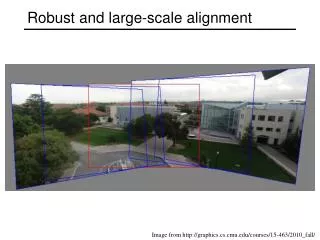
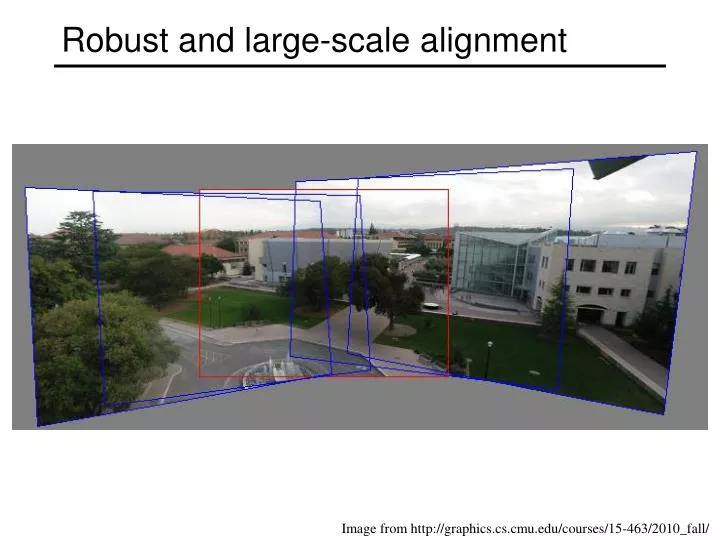
Robust and large-scale alignment Image from http://graphics.cs.cmu.edu/courses/15-463/2010_fall/
Robust feature-based alignment • So far, we’ve assumed that we are given a set of “ground-truth” correspondences between the two images we want to align • What if we don’t know the correspondences?
Robust feature-based alignment • So far, we’ve assumed that we are given a set of “ground-truth” correspondences between the two images we want to align • What if we don’t know the correspondences? ?
Robust feature-based alignment • Extract features
Robust feature-based alignment • Extract features • Compute putative matches
Robust feature-based alignment • Extract features • Compute putative matches • Loop: • Hypothesize transformation T
Robust feature-based alignment • Extract features • Compute putative matches • Loop: • Hypothesize transformation T • Verify transformation (search for other matches consistent with T)
Robust feature-based alignment • Extract features • Compute putative matches • Loop: • Hypothesize transformation T • Verify transformation (search for other matches consistent with T)
( ) ( ) Generating putative correspondences • Need to compare feature descriptors of local patches surrounding interest points ? ? = featuredescriptor featuredescriptor
Feature descriptors • Recall: covariant detectors => invariant descriptors Compute appearancedescriptors Detect regions Normalize regions
Feature descriptors • Simplest descriptor: vector of raw intensity values • How to compare two such vectors? • Sum of squared differences (SSD) • Not invariant to intensity change • Normalized correlation • Invariant to affine intensity change
Disadvantage of intensity vectors as descriptors • Small deformations can affect the matching score a lot
Feature descriptors: SIFT • Descriptor computation: • Divide patch into 4x4 sub-patches • Compute histogram of gradient orientations (8 reference angles) inside each sub-patch • Resulting descriptor: 4x4x8 = 128 dimensions David G. Lowe. "Distinctive image features from scale-invariant keypoints.”IJCV 60 (2), pp. 91-110, 2004.
Feature descriptors: SIFT • Descriptor computation: • Divide patch into 4x4 sub-patches • Compute histogram of gradient orientations (8 reference angles) inside each sub-patch • Resulting descriptor: 4x4x8 = 128 dimensions • Advantage over raw vectors of pixel values • Gradients less sensitive to illumination change • Pooling of gradients over the sub-patches achieves robustness to small shifts, but still preserves some spatial information David G. Lowe. "Distinctive image features from scale-invariant keypoints.”IJCV 60 (2), pp. 91-110, 2004.
Feature matching • Generating putative matches: for each patch in one image, find a short list of patches in the other image that could match it based solely on appearance ?
Feature space outlier rejection • How can we tell which putative matches are more reliable? • Heuristic: compare distance of nearest neighbor to that of second nearest neighbor • Ratio of closest distance to second-closest distance will be highfor features that are not distinctive • Threshold of 0.8 provides good separation David G. Lowe. "Distinctive image features from scale-invariant keypoints.”IJCV 60 (2), pp. 91-110, 2004.
Reading David G. Lowe. "Distinctive image features from scale-invariant keypoints.”IJCV 60 (2), pp. 91-110, 2004.
RANSAC • The set of putative matches contains a very high percentage of outliers • RANSAC loop: • Randomly select a seed group of matches • Compute transformation from seed group • Find inliers to this transformation • If the number of inliers is sufficiently large, re-compute least-squares estimate of transformation on all of the inliers • Keep the transformation with the largest number of inliers
RANSAC example: Translation Putative matches
RANSAC example: Translation Select one match, count inliers
RANSAC example: Translation Select one match, count inliers
RANSAC example: Translation Select translation with the most inliers
Scalability: Alignment to large databases • What if we need to align a test image with thousands or millions of images in a model database? • Efficient putative match generation • Approximate descriptor similarity search, inverted indices Test image ? Model database
Scalability: Alignment to large databases • What if we need to align a test image with thousands or millions of images in a model database? • Efficient putative match generation • Fast nearest neighbor search, inverted indexes Test image D. Nistér and H. Stewénius, Scalable Recognition with a Vocabulary Tree, CVPR 2006 Vocabulary tree with inverted index Database
Descriptor space Slide credit: D. Nister
Hierarchical partitioning of descriptor space (vocabulary tree) Slide credit: D. Nister
Vocabulary tree/inverted index Slide credit: D. Nister
Populating the vocabulary tree/inverted index Model images Slide credit: D. Nister
Model images Populating the vocabulary tree/inverted index Slide credit: D. Nister
Model images Populating the vocabulary tree/inverted index Slide credit: D. Nister
Model images Populating the vocabulary tree/inverted index Slide credit: D. Nister
Test image Model images Looking up a test image Slide credit: D. Nister
Voting for geometric transformations • Modeling phase: For each model feature, record 2D location, scale, and orientation of model (relative to normalized feature coordinate frame) index model
Voting for geometric transformations • Test phase: Each match between a test and model feature votes in a 4D Hough space (location, scale, orientation) with coarse bins • Hypotheses receiving some minimal amount of votes can be subjected to more detailed geometric verification index test image model
Indexing with geometric invariants • When we don’t have feature descriptors, we can take n-tuples of neighboring features and compute invariant features from their geometric configurations • Application: searching the sky: http://www.astrometry.net/ B C D A