Exploring the Solar System: Inner and Outer Planets
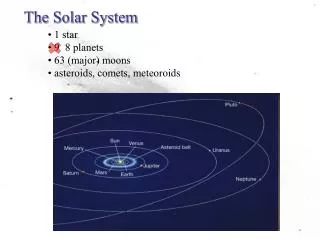
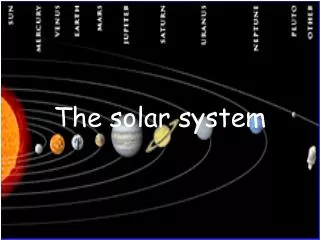
This educational overview presents the Solar System, detailing both the inner and outer planets. The inner planets - Mercury, Venus, Earth, and Mars - are characterized by their rocky surfaces and proximity to the Sun, earning them the title "terrestrial planets". In contrast, the outer planets - Jupiter, Saturn, Uranus, Neptune, along with dwarf planets Pluto and Eris - are gas giants, larger than Earth, with thick atmospheres. Discover the unique features of each planet, the distinction between standard and dwarf planets, and understand the rich diversity of our cosmic neighborhood.

Exploring the Solar System: Inner and Outer Planets
E N D
Presentation Transcript
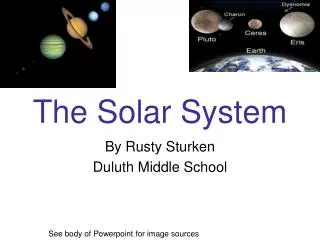
The Solar System By Rusty Sturken Duluth Middle School See body of Powerpoint for image sources
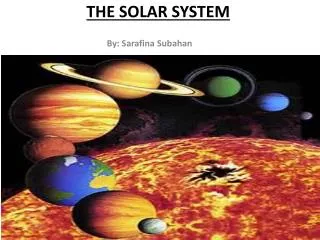
Another perspective Renamed Eris Image from http://media.skyandtelescope.com/images/TwelvePlanets_l.jpg
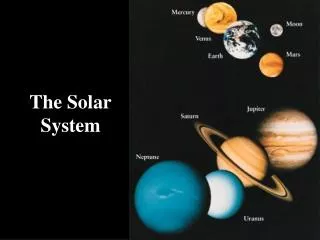
The Inner Planets • Mercury • Venus • Earth • Mars
Characteristics of the Inner Planets • They are 4 planets closest to the sun: Mercury, Venus, Earth and Mars. Located inside Asteroid Belt • Very similar to each other, they are small and have rocky surfaces. They are dense. Do NOT have rings • Often called “terrestrial planets” because they resemble Earth, “terra-” means “Earth”
Mercury Image on right from http://pds.jpl.nasa.gov/planets/images/browse/mercury/mercury1.jpg Image on left from http://astrogeology.usgs.gov/Projects/BrowseTheSolarSystem/gifs/mercury2.gif
Venus Phases of Venus Image from http://www.spacestationinfo.com/images/venus-phase1.gif Image on left from http://rocksfromspace.open.ac.uk/images/venus.jpg
Earth Image on right from http://z.about.com/d/space/1/7/c/e/earth_moon.jpg Image on left from http://www.physorg.com/newman/gfx/news/2005/earth12.jpg
Mars Image on left from http://www.lunarplanner.com/Images/Mars2003/Mars.jpg Image on right from http://www.spacetoday.org/images/Mars/MarsRovers2003/MarsRover2003_1.jpg
The Outer Planets • Jupiter • Saturn • Uranuspronounced“YOOR-a-nus”see • Neptune • Pluto (a dwarf Planet) http://www.nineplanets.org/say/uranus.au
Characteristics of The Outer Planets • These are the planets outside of the Asteroid Belt, they are: Jupiter, Saturn, Uranus, Neptune and the dwarf planets Pluto and Eris • Jupiter, Saturn, Uranus, and Neptune are called “Gas Giants” . They are much larger than Earth and do not have solid surfaces
Characteristics of The Outer Planets • Pluto and Eris are small and rocky, like the terrestrial planets. • The gas giants do not have well-defined surfaces but have deep atmospheres that are typically about 75% hydrogen, 24% helium, and 1% other elements • Gas giants likely have solid cores of rock, ice, frozen carbon dioxide and other compounds
Jupiter Jupiter and moon Io Image on left from http://pds.jpl.nasa.gov/planets/images/browse/jupiter/jupiter.jpg Image on right from http://www.spacetoday.org/images/SolSys/Jupiter/JupiterBelowIo2001.jpg
Saturn Image on right from http://www.adlerplanetarium.org/cyberspace/planets/saturn/images/saturns_ring_plane.jpg Image on left fromhttp://pds.jpl.nasa.gov/planets/images/full/saturn/saturn.jpg
Uranus Image on left from http://nssdc.gsfc.nasa.gov/planetary/image/uranus.jpg Image on right from http://www.nasa.gov/images/content/139938main_uranus_ring.jpg
Neptune Image on left from http://www.diracdelta.co.uk/science/source/n/e/neptune/neptune.jpg Image on right from http://upload.wikimedia.org/wikipedia/commons/6/63/Neptune-visible.jpg
The Dwarf Planets • Ceres- new dwarf planet, it was classified as the largest asteroid in the Asteroid Belt (it is between Mars & Jupiter). Say • Pluto- was classified as a planet, now classified as a dwarf planet • Eris- new dwarf planet, past Pluto it is an icy body near the edge of our solar system.
Planets and Dwarf Planets compared • Dwarf planets are smaller than planets • Both orbit the Sun • Both are large enough that their gravity pulls them into the shape of a sphere • Planets clear smaller objects out of their orbit. Dwarf planets can not because of their weaker gravity Information from http://www.windows.ucar.edu/tour/link=/our_solar_system/dwarf_planets/dwarf_planets.html
Pluto Image on left from http://www.crh.noaa.gov/Image/fsd/astro/Pluto1.jpg Image on right from http://www.jb.man.ac.uk/public/Pluto1.jpg
The Dwarf Planets and their Moons Image from http://www.windows.ucar.edu/our_solar_system/dwarf_planets/images/dwarf_planet_sizes_sm.jpg
Additional Sources • http://www.windows.ucar.edu/tour/link=/our_solar_system/dwarf_planets/dwarf_planets.html • http://www.pantheon.org/miscellaneous/pronunciations.html • http://www.nasa.gov • http://www.nineplanets.org