Introduction to Socket Programming in C: Communication Between Processes
This guide provides a comprehensive overview of socket programming in C, focusing on how processes communicate over a network using sockets. You'll learn how to create, bind, listen, accept, send, and receive messages using the UNIX Socket API. Key concepts include identifying the receiving process, defining IP addresses and ports, and establishing connections. With practical examples of TCP server and client implementations, this resource will help you understand the foundations of network programming.

Introduction to Socket Programming in C: Communication Between Processes
E N D
Presentation Transcript
Socket programming TasosAlexandridis HY335a - Socket Programming
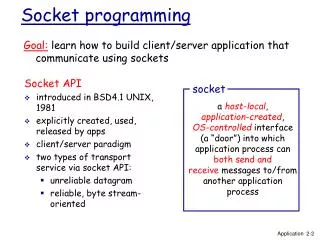
Socket: End Point of Communication • Sending message from one process to another • Message must traverse the underlying network • Process sends and receives through a socket • In essence, the doorway leading in/out of the house HY335a - Socket Programming
Identifying the Receiving Process • Sending process must identify the receiver • Address of the receiving end host • Identifier (port) that specifies the receiving process • Receiving host • Destination IP address (32-bit) uniquely identifies the host • Receiving process • Host may be running many different processes • Destination port (16-bit) uniquely identifies the socket (process) HY335a - Socket Programming
Using ports to identify Services HY335a - Socket Programming
Using sockets in C The UNIX Socket API HY335a - Socket Programming
Overview HY335a - Socket Programming
socket() • int socket(int domain, int type, int protocol) • Creates a socket • Domain specifies the protocol family • AF_UNIX, AF_LOCAL for local communication • AF_INET for IPv4 Internet protocols (use this) • Type specifies the communication • SOCK_STREAM for TCP • SOCK_DGRAM for UDP • Protocol specifies the protocol (set to 0 as domain and type imply the protocol) • RETURN • On success returns socket descriptor, else -1 HY335a - Socket Programming
bind() • int bind(intsocket, structsockaddr *address, intaddrLen) • Assigns a specific address to the socket • socket the socket descriptor • address the host address • addr_len the size of the address struct • RETURN • 0 on success, else -1 HY335a - Socket Programming
sockaddr & sockaddr_in structsockaddr_in { short intsin_family; // Address family unsigned short intsin_port; //Port number structin_addrsin_addr; //Internet address unsigned char sin_zero[8]; }; structin_addr { unsigned long s_addr; } structsockaddr_inaddr; structsockaddr *address = (structsockaddr *)&addr; //Type casting HY335a - Socket Programming
listen() • int listen(intsockfd, int backlog) • Listens (waits) for incoming connections • sockfd the socket descriptor • backlog max number of connections • RETURN • 0 on success, else -1 HY335a - Socket Programming
accept() • int accept(intsockfd, structsockaddr *addr, socklen_t *addrlen) • Accepts an incoming connection • sockfd the socket descriptor (after a call to listen() ) • addr pointer to a struct that is filled with the client’s address (optional) • addrlen the size of the addrstruct • RETURN • the new socket descriptor for the specific connection, or -1 if an error occurred HY335a - Socket Programming
send() / receive() • ssize_t send(intsockfd, const void *buf, size_tlen, int flags); • send data using the specified socket • ssize_trecv(intsockfd, void *buf, size_tlen, int flags); • Receive data from the specified socket and store it to buf • sockfd the socket descriptor • buf buffer to send or receiver • len the length of the buffer • flags (set to 0) • RETURN • The total number of bytes sent/received, else -1 HY335a - Socket Programming
connect() • int connect(intsockfd, const structsockaddr *addr, socklen_taddrlen) • Connect to a socket • sockfdthe unconnected socket descriptor • addr the server’s address • addrlen the size of the addrstruct • RETURN • On success 0, else -1 HY335a - Socket Programming
close() • int close(intfd) • Closes the socket • fd the socket descriptor • RETURN • 0 on success, else -1 HY335a - Socket Programming
Example TCP Server and TCP client in C HY335a - Socket Programming
Socket creation int sock; if((sock = socket(AF_INET,SOCK_STREAM,IPROTO_TCP)) < 0) { fprintf(stderr,”Failed to create TCP socket”); } if(setsockopt(sock, SOL_SOCKET, SO_REUSEADDR, &optval, sizeof(optval)) < 0) { fprintf(stderr,”could not reuse address”); } Reuse the same port number HY335a - Socket Programming
Bind port to socket structsockaddr_inaddr; memset(&addr, 0 ,sizeof(addr)); //clear memory block for //addr addr.sin_family = AF_INET; addr.sin_addr.s_addr = INADDR; addr.sin_port = htons(server_port); if(bind(sock, (structsockaddr *)&addr, sizeof(addr)) < 0) { fprintf(stderr,”cannot bind socket to address”); } HY335a - Socket Programming
Wait for incoming connections If(listen (sock, 5) < 0) { fprintf(stderr,”error listening”); } Specifies max number of incoming connections HY335a - Socket Programming
Client establishes connection structsockaddr_in sin; structhostent *host = gethostbyname(argv[1]); sin.sin_addr = *(in_addr_t) *host->h_addr_list[0]; memset(&sin,0,sizeof(sin)); sin.sin_family = AF_INET; sin.sin_addr.s_addr = server_addr; // = inet_addr(server_IP) ; sin.sin_port = htons(server_port); if(connect(sock, (structsockaddr *)&sin, sizeof(sin)) < 0) { fprintf(stderr, “cannot connect to server”); } use raw IP address HY335a - Socket Programming
Accept incoming connections structsockaddr_inaddr; intaddr_len = sizeof(addr); intc_sock; c_sock = accept(sock, (structsockaddr*)&addr, &addr, &addr_lin); if(c_sock < 0) { fprintf(stderr,”error accepting connection”); } HY335a - Socket Programming
Send data intsend_packets(char *buffer, intbuf_len) { sent_bytes = send(sock, buffer, buf_len, 0) ; if(send_bytes < 0) { fprintf(stderr, “send() failed”); } return 0; } HY335a - Socket Programming
Receive data intreceive_packets ( char *buffer, intbuf_len) { intnum_received = recv(sock, buffer, buf_len, 0); if(num_received < 0) { fprintf(stderr,”recv() failed”); } else if (num_received == 0) { //sender has closed connection return EOF; } else { return num_received; } What happens when data exceed buffer size? HY335a - Socket Programming
#include the appropriate libraries #include <unistd.h> /* access to system calls */ #include <sys/types.h> /*widely used types */ #include <netdb.h> /* gethostbyname() etc.*/ #include <arpa/inet.h> /*htons etc. */ #include <sys/socket.h> /*socket structs */ #include <netinet/in.h> /*internet sockets, sockaddr_in etc. */ HY335a - Socket Programming
Datagram Sockets (UDP) • Similar to stream sockets but: • Use SOCK_DGRAM instead of SOCK_STREAM • No need to establish and terminate connection • Use recvfrom() and sendto() instead of recv() and send() ssize_trecvfrom(intsockfd, void *buf, size_tlen, int flags, structsockaddr *src_addr, socklen_t *addrlen); ssize_tsendto(intsockfd, const void *buf, size_tlen, intflags,conststructsockaddr *dest_addr, socklen_taddrlen); HY335a - Socket Programming
Using sockets in Java HY335a - Socket Programming
TCP Client public static void main(String argv[]) throws Exception { String sentence = “Hello”; String modifiedSentence; //create the socket Socket clientSocket = new Socket(“hostname”, port); //get the input and output stream that are attached to the socket DataOutputStreamoutToServer = new DataOutputStream(clientSocket.getOutputStream()); BufferedReaderinFromServer = new BufferedReader(new InputStreamReader(clientSocket.getInputStream())); outToServer.writeBytes(sentence + ‘\n’); //send modifiedSentence = inFromServer.readLine(); //receive System.out.println(“From server: “ + modifiedSentence); clientSocket.close(); //close the socket } HY335a - Socket Programming
TCP Server public static void main(String argv[]) throws Exception { //create the server socket ServerSocketwelcomeSocket = new ServerSocket(port); //accept the connection Socket connectionSocket = welcomeSocket.accept(); //get the streams DataOutputStreamoutToClient = new DataOutputStream(connectionSocket.getOutputStream()); BufferedReaderinFromClient = new BufferedReader(new InputStreamReader(connectionSocket.getInputStream())); //receive from client String clientSentence = inFromClient.readLine(); //send to client outToClient.writeBytes(clientSentence.toUpperCase()); } HY335a - Socket Programming
Datagram Sockets(UDP) in Java • No initial handshaking and therefore no need for welcoming socket (server socket) • No streams are attached to the sockets • The receiving process must unravel the received packet to obtain the packet’s information bytes • The sending host creates "packets" by attaching the IP destination address and port number to each batch of bytes it sends HY335a - Socket Programming
UDP Client public static void main(String args[]) throws Exception { BufferedReaderinFromUser = new BufferedReader(new InputStreamReader(System.in)); DatagramSocketclientSocket = new DatagramSocket(); //UDP //Socket InetAddressIPAddress = InetAddress.getByName("hostname"); String sentence = inFromUser.readLine(); byte[] receiveData = new byte[1024]; byte[] sendData = sentence.getBytes(); HY335a - Socket Programming
UDP Client DatagramPacketsendPacket = new DatagramPacket(sendData, sendData.length, IPAddress, 9876); clientSocket.send(sendPacket); //send a UDP packet DatagramPacketreceivePacket = new DatagramPacket(receiveData, receiveData.length); clientSocket.receive(receivePacket); //receive a UDP packet String modifiedSentence = new String(receivePacket.getData()); System.out.println("FROM SERVER:" + modifiedSentence); clientSocket.close(); } HY335a - Socket Programming
UDP Server public static void main(String args[]) throws Exception { DatagramSocketserverSocket = new DatagramSocket(9876); byte[] receiveData = new byte[1024]; byte[] sendData = new byte[1024]; DatagramPacketreceivePacket = new DatagramPacket(receiveData, receiveData.length); serverSocket.receive(receivePacket); String sentence = new String(receivePacket.getData()); HY335a - Socket Programming
UDP Server InetAddressIPAddress = receivePacket.getAddress(); int port = receivePacket.getPort(); String capitalizedSentence = sentence.toUpperCase(); sendData = capitalizedSentence.getBytes(); DatagramPacketsendPacket = new DatagramPacket(sendData, sendData.length, IPAddress, port); serverSocket.send(sendPacket); } HY335a - Socket Programming
Classes • ServerSocket • Socket • DatagramSocket • DatagramPacket • InetAddress http://download-llnw.oracle.com/javase/1.5.0/docs/api/ (Java API) HY335a - Socket Programming