
Understanding Compressed Air Quality Classes and Leakage Costs According to ISO 8573-1
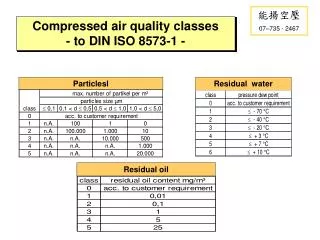
This document provides an in-depth analysis and practical examples of compressed air quality classes based on DIN ISO 8573-1 standards, focusing on the implications of residual water and oil. It highlights the impact of leakage holes on air quantity and associated costs, offering insights on power loss in kW and yearly financial implications in NT$ for various hole diameters. Additionally, it explains the concepts of dew point temperature for both atmospheric and pressure conditions to help users maintain optimal air quality.

Understanding Compressed Air Quality Classes and Leakage Costs According to ISO 8573-1
E N D
Presentation Transcript
Particlesl Residual water Residual oil 能揚空壓 07–735 - 2467 Compressed air quality classes- to DIN ISO 8573-1 -
能揚空壓 07–735 - 2467 洩漏的損失 Leakage hole [mm] Escaping air quantity at 8 bar [l/min] Losses Power Costs [kW] [NT$/a] 1 75 0.60 10,512 1.5 150 1.30 22,776 2 260 2.00 35,040 3 600 4.40 77,088 4 1100 8.80 154,176 5 1700 13.20 231,264 Example: Hole diameter: 3 mm 4.4 kW * 8760 h/a * 2 NT$/kWh =77,088 NT$ /year
能揚空壓 07–735 - 2467 壓力換算
能揚空壓 07–735 - 2467 流量換算
DP in °C 20 0 -20 -40 -60 -40 -20 0 +20 +40 Dewpoint is lower by 20 to 30 °C than the pressure dewpoint ! 能揚空壓 07–735 - 2467 大氣露點&壓力露點 Dewpoint (DP) Temperature of the atmospheric air after which the condensation of water vapor begins. 5 bar 7 bar 10 bar Pressure dewpoint (PDP) Temperature of the compressed air after which the condensation of water vapor begins. PDP in °C Example: PDP + 5 °C at 7 bar corresponds to a DP of -20 °C