
Baseline Survey of Deep Sea Anemones in the Northeastern Pacific Ocean
This study focuses on the largely unexplored populations of sea anemones in the deep northeastern Pacific Ocean, particularly in the context of the growing oxygen minimum zone (OMZ) off the Oregon coast. While shallow-water anemones are well-documented, the distribution and ecology of deep-sea species remain largely unknown. The survey identifies 13 of roughly 25 species, assesses their tolerance to low oxygen, and provides vital baseline data to understand how these organisms may be affected by hypoxia and anoxia in their environments.

Baseline Survey of Deep Sea Anemones in the Northeastern Pacific Ocean
E N D
Presentation Transcript
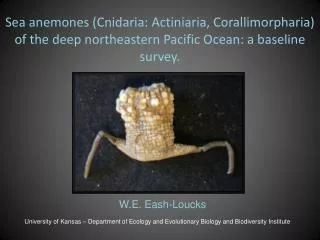
Sea anemones (Cnidaria: Actiniaria, Corallimorpharia) of the deep northeastern Pacific Ocean: a baseline survey. W.E. Eash-Loucks University of Kansas – Department of Ecology and Evolutionary Biology and Biodiversity Institute
Why Study Deep Sea Anemones? • Very little is known about the fauna and their distribution • Much is known about shallow water anemones • Growing oxygen minimum zone off the coast of Oregon
Oxygen Minimum Zones (OMZs) • ~150 worldwide • Low oxygen • Hypoxia • Anoxia • Below photic zone • Areas where little mixing occurs • Can be natural or manmade http://earthguide.ucsd.edu
The OMZ off the Coast of Oregon • Caused by upwelling • High nutrients • Low oxygen • Strongest in summer • Growing mcbi.org Chan et al., 2007
Effects of OMZ on Marine Life • Increased mortality • Cnidarians have high tolerance to low O2 • Sea anemones are likely to be the last group effected Grantham et al., 2004 Vaquer-Sunyer and Duarte, 2008
Establishing a Baseline • Southern California to British Columbia • 60 – 4,100 m • 1960s – 1970s • Approximately 25 species • 13 studied closely • Large • Abundant
Methods for Species Identification • External Anatomy • Body form and color • Tentacle number and arrangement • Internal Anatomy • Histology • Cnidae etc.usf.edu
Previously Described Species • Metridium farcimen • Paractinostola faeculenta • Anthosactis nomados • Actinauge verrillii • Paraphelliactis pabista
Previously Described Species • Corallimorphus denhartogi • Monactis vestita • Bathyphellia australis • Liponema brevicornis
New/Unidentified Species • Bolocera sp. • Actinoscyphia n. sp. • Sicyonis n. sp. • Member of Family Sagartiidae
Summary • OMZ in northeastern Pacific Ocean poses a threat to marine life • Established baseline of anemone fauna can be used to make conclusions about how anemones are effected by the growing OMZ • Identified 13 of approximately 25 species of deep sea anemones
Acknowledgments • Funding • Department of Ecology and Evolutionary Biology, Travel Fund • Biodiversity Institute, Panorama Society Small Grant • Specimen Loans • Santa Barbara Museum of Natural History • Daphne Fautin