Download
1 / 3
30 likes | 135 Vues
Explore background due to p/K interaction with Si atoms, include all interactions, extract info with basic principles. Investigate elastic scattering as most common interaction type. Study angles for entering Straw chambers and reject scattering based on energy release. Address interaction challenges in ASIC chip or micro-channel cooling support, suggest reducing chip thickness.

E N D
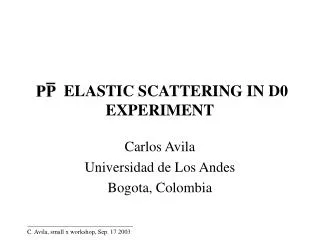
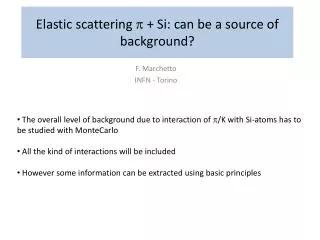
Elasticscatteringp + Si: can be a source of background? • The overalllevelof background due tointeractionofp/K withSi-atomshastobestudiedwithMonteCarlo • All the kindofinteractionswillbeincluded • However some information can beextractedusingbasicprinciples F. Marchetto INFN - Torino
I triedtoexamine the elasticscatteringwhichis the mostcopious ( about 50 mb) among the single interactiontypes. • The elasticinteractionprobabilityisaround 10-4 , while the total interactionprobabilitywillbeoneorderofmagnitudelarger. q Si 1.25 mrad < q < 15 mrad: toenterinto the Strawchambers
Theseanglescorrespondto a kineticenergyof: 200 keV and 22 MeV, whichtranslateinto a rangeofSiliconnucleusoflessthan 1 micron and 6 micron, respectively. Numberofequivalentmipsassumingthatall the energy loss goesintoionization From 3 mrad up, oneshouldbeabletoreject the elasticscattering on the basisof the energyreleased in the detector. But… thatisnottrueif the interactionhappens in the ASIC chip or micro-channelcoolingsupport. The nucleuswillremain, with a high probability, in the blind structureitselfand thereis no way to spot it. Forthisparticular background source, oneshouldreduce the chip thickness.