Next Gen AQ model
50 likes | 146 Vues
Transitioning from global to urban scales, minimize errors, and enhance standards in air quality modeling. Integrated meteorology-chemistry models at various resolutions improve atmospheric chemistry understanding. Developments towards on-line chemistry in global models like OLAM-Chem and MPAS. Collaborative efforts crucial for model interoperability and standardized engineering.


Next Gen AQ model
E N D
Presentation Transcript
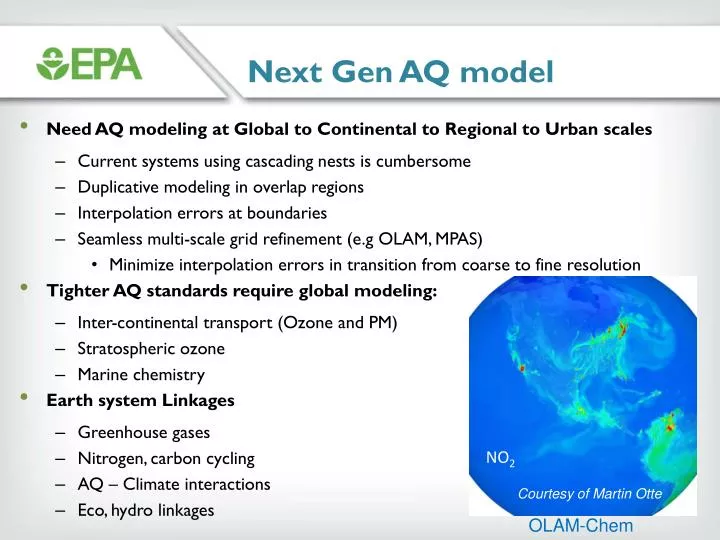
Next Gen AQ model Need AQ modeling at Global to Continental to Regional to Urban scales • Current systems using cascading nests is cumbersome • Duplicative modeling in overlap regions • Interpolation errors at boundaries • Seamless multi-scale grid refinement (e.g OLAM, MPAS) • Minimize interpolation errors in transition from coarse to fine resolution Tighter AQ standards require global modeling: • Inter-continental transport (Ozone and PM) • Stratospheric ozone • Marine chemistry Earth system Linkages • Greenhouse gases • Nitrogen, carbon cycling • AQ – Climate interactions • Eco, hydro linkages NO2 Courtesy of Martin Otte OLAM-Chem
Need for online Met-Chem model Growing trend toward integrated Met-Chem modeling • Improve NWP – radiative feedbacks and satellite data assimilation • Regional climate-chemistry modeling including SLCF • Improve AQ modeling Chem affects Met which affects AQ • Aerosol direct effects • Reduced SW ground reduces PBL greater concentrations • Aerosol indirect effects • Effects cloud cover, COD, radiative forcing, precipitation • Effects propagate through AQ • Gaseous direct effects on LW • Ozone, methane, N2O, etc • AQ effects on land surface • Ozone damages stomatal function which affects: • Transpiration, CO2 uptake, dry deposition • CO2 changes, including regulatory controls, affect stomatal conductance BAMS 2014 Jiandong Wang et al., 2014, ERL
Vision Extend to global scales • Single global mesh with seamless refinement to local scales • Integrated chemistry, dynamics, physics Three configurations of flexible systems: • On-line global variable grid (e.g. MPAS, OLAM) • Online regional (WRF-AQ) • Offline regional (redesigned CMAQ) Interoperability of as much model code as possible • Gas, aerosol, aqueous in modular box • Modules for biogenic emissions, dry dep/bidi, wind-blown dust, photolysis, etc Transport in met models for online systems (adv, diffusion) • Ensure mass conservation • Consistency with met parameters • Minimize numerical diffusion and dispersion MPAS
Community development Initial discussions among EPA, NCAR, NOAA, DOE • Leverage diverse expertise across community Multiple purposes: • Air quality policy development and regulation • Air quality forecasting • Atmospheric chemistry research • Climate modeling with short-lived climate forcers • Earth system applications: coupled system for air, hydro, eco, ag, energy, etc… Standardize model engineering for coupling chemical components to different dynamics models Initial steps: add chemistry to existing global models • For example: MPAS-Chem, OLAM-Chem Involve grant programs to foster development • EPA STAR grants • DOE Model development grants
Integrated Met-Chem modeling High temporal coupling (data exchange frequency > once per hour) • Better resolve high-frequency meteorological dynamics • WS, WD changes, PBL height variations, cloud formation, rainfall • Affects chemical transport, transformation, and removal at high spatial resolution More consistent dynamical, physical, and numerical modeling • More constant cloud convective transport of chemistry and met • Closer integration of cloud microphysics and aqueous chemistry • More consistent advection and diffusion On-line chemistry necessary for global models with non-uniform, refining grid meshes (e.g. OLAM, MPAS) • Advection and horizontal diffusion must be integrated in dynamics solver