Download
1 / 47
470 likes | 581 Vues
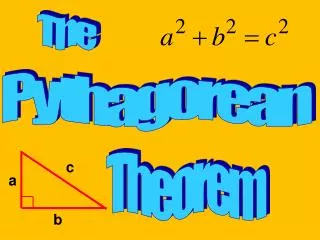
The Pythagorean Theorem is a fundamental principle in geometry, discovered by the Greek mathematician Pythagoras approximately 2,500 years ago. This theorem states that in a right triangle, the square of the length of the hypotenuse (the side opposite the right angle) equals the sum of the squares of the lengths of the other two sides (the legs). This relationship can be expressed as (c^2 = a^2 + b^2). The theorem can be applied in various practical scenarios, such as calculating distances and solving geometric problems involving right triangles.

E N D
The Pythagorean Theorem c a b
We call it a right triangle because it contains a rightangle.
The little square in the angle is telling you that it is a right angle. 90o
About 2,500 years ago, a Greek mathematician named Pythagoras discovered a special relationship that exists between the three sides of every right triangle.
5 3 4 Pythagorus realized that if you have a right triangle,
5 3 4 when you square the lengths of the two sides that make the right angle,
5 3 4 and then add the squares together,
5 3 4 the sum is the same value you get when you square the longest side.
Is that correct? ? Does: ? √
10 8 6 It is, and the same is true for any right triangle. √
The two sides which come together in a right angle are called
The two sides which come together in a right angle are called
The two sides that together form the right angle are called the LEGS.
The side across from the right angle is called the hypotenuse. a b
And the length of the hypotenuse is usually labeled c. c a b
The relationship Pythagoras discovered is now called The Pythagorean Theorem: c a b
The Pythagorean Theorem states that, given a right triangle with legs a and b and hypotenuse c, c a b
then . . . c a b
then . . . = c2 c a2 a b + b2
then . . . = 52 = 25 16 42 4 5 3 + 32 9
You can use The Pythagorean Theorem to solve many kinds of problems. Suppose you drive directly west for 48 miles, 48
Using The Pythagorean Theorem, 48 482 + 362 = c2 36 c
48 482 + 362 = c2 36 c Why? Can you see that we have a right triangle?
48 482 + 362 = c2 36 c Which side is the hypotenuse? Which sides are the legs?
Then all we need to do is calculate: √ √ 60 = c
So, since c2 is 3600, c is 60. And you end up 60 miles from where you started. So, since c2 is 3600, c is 48 36 60
15" 8" Find the length of a diagonal of the rectangle: ?
15" 8" Find the length of a diagonal of the rectangle: ? b = 8 c a = 15
c b = 8 a = 15
15" 8" Find the length of a diagonal of the rectangle: 17”
Practice using The Pythagorean Theorem to solve these right triangles:
c 5 12 = 13
b 10 26
b 10 26 Think: c2 b2 = a2 +
b 10 26 So: c2 - a2 b2 =
b 10 26 (a) (c)
b 10 26 (a) (c) 262 b2 = 102 +
b 10 26 (a) (c) 676 - b2 100 =
b 10 26 (a) (c) b2 576 = 24 √
b 10 26 = 24 (a) (c) c2 676 √ b2 576 = + a2 100
12 b 15 Your Turn! a2 + b2 = c2 (a) a = 12 c = 15 Awesome! = 9 (c) (b) a2 + b2 = c2 (12)2 + b2 = (15)2 (144) + b2 = (225) b2 = (225) - (144) b2 = 81 b = √81
Your Turn! a = 24 b = 32 Find the length of the diagonal. 32 in a2 + b2 = c2 (b) (24)2 + (32)2 = c2 24 in (a) =40 (c) (576) + (1024) = c2 c2 = (1600) √c2 = √1600 c = 40 The length of the diagonal is 40 inches.