Comparative Study of Conventional vs. Frozen Elephant Trunk Surgery for Thoracic Aorta Aneurysms
This retrospective comparative study evaluates the short- and mid-term outcomes of Conventional Elephant Trunk (ET) and Frozen Elephant Trunk (FET) surgical procedures in patients with extensive aneurysmal disease of the thoracic aorta. Conducted by a collaboration of cardiac surgery departments in Italy and Germany, the research aims to fill the gap in existing literature regarding these surgical techniques. Results indicate that both ET and FET are associated with similarly satisfactory outcomes, suggesting both methods are viable options for treating extensive thoracic aorta aneurysms.

Comparative Study of Conventional vs. Frozen Elephant Trunk Surgery for Thoracic Aorta Aneurysms
E N D
Presentation Transcript
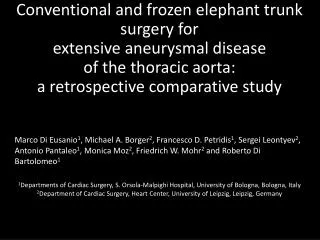
Conventional and frozen elephant trunk surgery for extensive aneurysmal disease of the thoracic aorta: a retrospective comparative study Marco Di Eusanio1, Michael A. Borger2, Francesco D. Petridis1, SergeiLeontyev2, Antonio Pantaleo1,Monica Moz2, Friedrich W. Mohr2and Roberto Di Bartolomeo1 1Departments of Cardiac Surgery, S. Orsola-Malpighi Hospital, University of Bologna, Bologna, Italy 2Department of CardiacSurgery, Heart Center, University of Leipzig, Leipzig, Germany
BACKGROUND Different surgical and hybrid procedures are available to treat patients with extensive disease of the thoracic aorta. No comparative studies exist comparing short- and mid-term outcomes after extensive aneurysm repair using the Conventional Elephant Trunk (ET) and the Frozen Elephant Trunk (FET) procedures. Here we report our experience
STUDY POPULATION Exclusioncriteria: aortic dissection descending thoracic aorta < 40 mm thoraco-abdominal aneurysm method of brain protection other then antegradeselective brain perfusion
CONCLUSION In patients with extensive aneurysms of the thoracic aorta ET and FET procedures were associated with similar satisfactory short- and mid-term outcomes. Longer-term follow up are warranted