WGU Data Management Foundations PDF Dumps
Easily download the WGU Data Management Foundations PDF Dumps from Passcert to keep your study materials accessible anytime, anywhere. This PDF includes the latest and most accurate exam questions and answers verified by experts to help you prepare confidently and pass your exam on your first try.

WGU Data Management Foundations PDF Dumps
E N D
Presentation Transcript
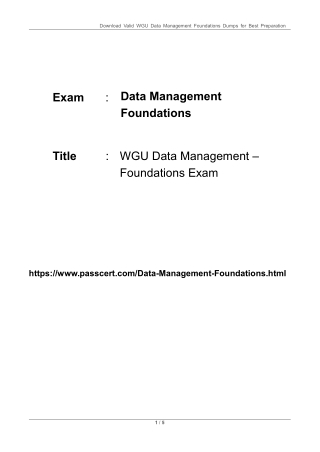
Download Valid WGU Data Management Foundations Dumps for Best Preparation Data Management Foundations Exam : Title : WGU Data Management – Foundations Exam https://www.passcert.com/Data-Management-Foundations.html 1 / 5
Download Valid WGU Data Management Foundations Dumps for Best Preparation 1.What is the role of the database administrator? A. The database administrator is a consumer of data in a database. B. The database administrator is responsible for securing the database system against unauthorized users. C. The database administrator determines the format of each data element and the overall database structure. D. The database administrator develops computer programs that utilize a database. Answer: B Explanation: A Database Administrator (DBA) is responsible for the management, security, and performance of a database system. This includes controlling access to data, ensuring database integrity, optimizing performance, managing backups, and protecting the system from unauthorized access. Option A (Incorrect): A DBA is not just a consumer of data but is primarily responsible for the database’s management. Option B (Correct): Security is one of the key responsibilities of a DBA, including enforcing user access controls and implementing encryption and authentication mechanisms. Option C (Incorrect): While DBAs work with data structures, it is typically the role of a data architect or database designer to define data formats and schema structures. Option D (Incorrect): Developing application programs that interact with the database is typically the role of software developers or database programmers, not DBAs. Reference: Database Administration best practices from SE 3050 zyBooks. 2.What is the role of the transaction manager within the database system architecture? A. The transaction manager uses information from the catalog to perform query optimization. B. The transaction manager is composed of a query processor, storage manager, transaction manager, log, and catalog. C. The transaction manager logs insert, update, and delete queries, and the result is sent back to the application. D. The transaction manager translates the query processor instructions into filesystem commands and uses an index to quickly locate the requested data. Answer: C Explanation: A Transaction Manager ensures ACID (Atomicity, Consistency, Isolation, Durability) properties in database transactions. It manages concurrent transactions, ensuring no conflicts occur and logs modifications to support recovery mechanisms. Option A (Incorrect): Query optimization is managed by the query processor, not the transaction manager. Option B (Incorrect): The transaction manager is a component of the database architecture but is not composed of the entire system (query processor, storage manager, etc.). Option C (Correct): The transaction manager logs transactions like INSERT, UPDATE, and DELETE, ensuring consistency and recoverability. Option D (Incorrect): The storage manager is responsible for translating queries into file system commands. Reference: Transaction Management section in SE 3050 zyBooks. 2 / 5
Download Valid WGU Data Management Foundations Dumps for Best Preparation 3.Which product has an open-source license in addition to having a non-relational system? A. MongoDB B. SQL Server C. MySQL D. Oracle Database Answer: A Explanation: MongoDB is a NoSQL (non-relational) database that is open-source and supports document-oriented storage. It allows for flexible schema design and is optimized for big data applications. Option A (Correct): MongoDB is a NoSQL database with an open-source AGPL license, making it both free to use and non-relational. Option B (Incorrect): SQL Server is a relational database (RDBMS) developed by Microsoft and is not open-source. Option C (Incorrect): MySQL is open-source but is a relational database (RDBMS), not a NoSQL system. Option D (Incorrect): Oracle Database is relational and proprietary (not open-source). Reference: Database Management Systems Comparison. 4.Which description defines a data type? A. It is a named set of values. B. It is an unnamed tuple of values. C. It has values corresponding to columns. D. It has a name and a varying set of rows. Answer: A Explanation: A data type defines the kind of data a column can store in a database. It ensures data consistency and efficient storage. Option A (Correct): A data type is a named set of values, such as INTEGER, VARCHAR, DATE, etc. Option B (Incorrect): A tuple refers to a row in a relational database, not a data type. Option C (Incorrect): Data types define column values, but they do not correspond directly to columns. Option D (Incorrect): Data types do not have a varying set of rows; they define attributes for columns. Reference: Data types in relational databases. 5.What does the aggregate function do? A. It computes values over a set of rows. B. It selects rows that appear in one table but not another. C. It eliminates one or more columns of a table. D. It lists combinations of rows in two tables. Answer: A Explanation: An aggregate function performs a calculation over multiple rows and returns a single value. Examples include SUM(), AVG(), MAX(), MIN(), and COUNT() in SQL. Option A (Correct): Aggregate functions compute values over a set of rows, like summing total sales or averaging grades. Option B (Incorrect): Selecting rows that appear in one table but not another is done using set operations 3 / 5
Download Valid WGU Data Management Foundations Dumps for Best Preparation (EXCEPT or MINUS in SQL). Option C (Incorrect): Eliminating columns is done using the PROJECT operation or SELECT with specific columns. Option D (Incorrect): Combining rows from two tables refers to a JOIN operation, not aggregation. Reference: Aggregate functions in relational algebra. 6.Which capability should databases maintain to simplify the use of SQL with a general-purpose language? A. The storage manager to interpret low-level file-system commands B. The ability to reverse results if needed C. The query processor to deliver results D. The use of an application programming interface Answer: D Explanation: Databases need to support Application Programming Interfaces (APIs) to enable seamless integration with general-purpose programming languages like Python, Java, and C#. APIs like ODBC (Open Database Connectivity) and JDBC (Java Database Connectivity) allow applications to interact with databases without requiring complex SQL commands. Option A (Incorrect): The storage manager is responsible for managing low-level file system operations, but it does not simplify SQL integration with programming languages. Option B (Incorrect): The ability to reverse results (e.g., using ORDER BY DESC) is a SQL feature but is unrelated to integration with programming languages. Option C (Incorrect): The query processor optimizes and executes SQL queries but does not provide an interface for application development. Option D (Correct): APIs allow databases to be accessed easily from different programming environments, simplifying integration. Reference: Database connectivity using APIs in SE 3050 zyBooks. 7.What is the role of a query processor in the database system architecture? A. It uses information from the catalog to perform query optimization. B. It writes log records before applying changes to the database. C. It translates instructions into file system commands. D. It sends results back to the application that requested the queries. Answer: A Explanation: A query processor is responsible for query optimization and execution in a database management system (DBMS). It analyzes SQL statements, optimizes execution plans, and ensures efficient retrieval of data. Option A (Correct): The query processor optimizes queries by analyzing metadata from the system catalog to determine the best execution strategy. Option B (Incorrect): Logging transactions before applying changes is the responsibility of the transaction manager. Option C (Incorrect): Translating instructions into file system commands is handled by the storage manager, not the query processor. Option D (Incorrect): While the query processor helps retrieve results, the database engine and API layer 4 / 5
Download Valid WGU Data Management Foundations Dumps for Best Preparation are responsible for returning results to applications. Reference: Query optimization and execution in relational databases. 8.Which syntax feature classifies the explicit string, numeric, or binary values used in SQL queries? A. Literals B. Comments C. Identifiers D. Keywords Answer: A Explanation: In SQL, literals represent explicit values such as numbers, strings, or binary data directly written into queries. For example: SELECT * FROM Employees WHERE Salary > 50000; Here, 50000 is a numeric literal. Option A (Correct): Literals are explicit values used in SQL queries, such as 123, 'John Doe', and TRUE. Option B (Incorrect): Comments are non-executable text used for documentation within SQL code, typically denoted by -- or /* ... */. Option C (Incorrect): Identifiers are names of tables, columns, or other database objects, such as Employee ID. Option D (Incorrect): Keywords are reserved words in SQL (e.g., SELECT, FROM, WHERE) that define operations and syntax. Reference: SQL syntax fundamentals in SE 3050 zyBooks. 9.Which keyword can be used as a clause in an ALTER TABLE statement? A. DELETE B. CHANGE C. STOP D. AGGREGATE Answer: B Explanation: The ALTER TABLE statement is used to modify an existing database table structure. One common clause is CHANGE, which allows renaming a column and modifying its data type. Example: sql ALTER TABLE Employees CHANGE COLUMN OldName NewName VARCHAR(50); Option A(Incorrect): DELETE is used to remove rows, not alter table structure. Option B (Correct): CHANGE is a valid clause for renaming and modifying columns in MySQL and some other databases. Option C (Incorrect): STOP is not a valid SQL keyword for altering tables. Option D (Incorrect): AGGREGATE refers to functions like SUM() and AVG(), not table alterations. Reference: SQLALTER TABLE syntax in SE 3050 zyBooks. 5 / 5