Propositional Logic and Inference Techniques in AI
This document outlines key concepts in Propositional Logic, including fundamental syntax, semantics, and inference procedures. It discusses the evolution from problem-specific AI to general-purpose AI, emphasizing the importance of formal languages in knowledge representation. Exercises are provided to enhance understanding of semantic relationships and inference, illustrated through examples like the Wumpus World. Additionally, students are reminded to focus on the course's homework requirements and use of semantic networks.

Propositional Logic and Inference Techniques in AI
E N D
Presentation Transcript
Propositional Logic Reading: C. 7.4-7.8, C. 8
Announcements • Read discussion board frequently • Questions answered • New posts of client-server • Today: version posted with improved IO on display and timing • Mid-term evaluation on courseworks • Complete by next Tuesday (1 week) • Written homework • Do not do “predicate logic” on problem 10.5 (will be part of next assignment) • Should read “but use semantic networks and KL-one type ” .. Do not extend the representation itself. • Note that section 10.6 covers semantic networks and description logics (another name for KL-one type)
Logic: Outline • Propositional Logic • Inference in Propositional Logic • First-order logic • Inference in FOL
Agents that reason logically • A logic is a: • Formal language in which knowledge can be expressed • A means of carrying out reasoning in the language • A Knowledge base agent • Tell: add facts to the KB • Ask: query the KB
Towards General-Purpose AI • Problem-specific AI (e.g., Roomba) • Specific data structure • Need special implementation • Can be fast • General –purpose AI (e.g., logic-based) • Flexible and expressive • Generic implementation possible • Can be slow
Language Examples • Programming languages • Formal, not ambiguous • Lacks expressivity (e.g., partial information) • Natural Language • Very expressive, but ambiguous: • Flying planes can be dangerous. • The teacher gave the boys an apple. • Inference possible, but hard to automate • Good representation language • Both formal and can express partial information • Can accommodate inference
Components of a Formal Logic • Syntax: symbols and rules for combining themWhat you can say • Semantics: Specification of the way symbols (and sentences) relate to the worldWhat it means • Inference Procedures: Rules for deriving new sentences (and therefore, new semantics) from existing sentencesReasoning
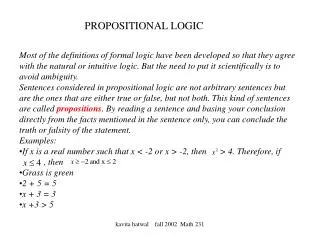
Semantics • A possible world (also called a model) is an assignment of truth values to each propositional symbol • The semantics of a logic defines the truth of each sentence with respect to each possible world • A model of a sentence is an interpretation in which the sentence evaluates to True • E.g., TodayIsTuesday -> ClassAI is true in model {TodayIsTuesday=True, ClassAI=True} • We say {TodayIsTuesday=True, ClassAI=True} is a model of the sentence
Exercise: Semantics What is the meaning of these two sentences? • If Shakespeare ate Crunchy-Wunchies for breakfast, then Sally will go to Harvard • If Shakespeare ate Cocoa-Puffs for breakfast, then Sally will go to Columbia
Examples • What are the models of the following sentences? • KB1: TodayIsTuesday -> ClassAI • KB2: TodayIsTuesday -> ClassAI, TodayIsTuesday
Proof by refutation • A complete inference procedure • A single inference rule, resolution • A conjunctive normal form for the logic
Example: Wumpus World • Agent in [1,1] has no breeze • KB = R2Λ R4 = (B1,1<->(P1,2) V P2,1)) Λ⌐B1,1 • Goal: show ⌐P1,2