Understanding Value Creation and Competitive Advantage in Economics
This class discusses the economics of competitive strategy, focusing on value creation and sustainable competitive advantage. It highlights how buyer benefits minus input costs contribute to consumer surplus and profit, exploring pricing strategies of branded vs. generic products. Different customer types have varied willingness to pay, impacting pricing before and after patent expirations. Concepts like vertical differentiation and market positioning are crucial, emphasizing the need for firms to differentiate and optimize strategies to avoid price wars and achieve sustained profitability.

Understanding Value Creation and Competitive Advantage in Economics
E N D
Presentation Transcript
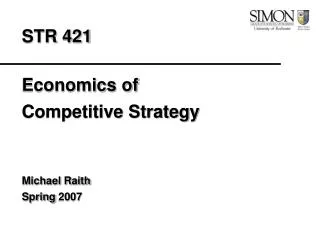
STR 421 Economics of Competitive Strategy Michael Raith Spring 2007
Today’s class 2. Value creation and competitive advantage 2.1 Value creation and positioning 2.2 Friday: Sustainability of a competitive advantage
Value • Value Created = Buyer’s benefit - Cost of inputs = B - C = (B - P) + (P - C) = Consumer Surplus + Profit • The price P determines how much of the value created is captured by the seller, and how much by the buyer.
Value and competition • Example: pricing of Glaxo’s Paxil vs. generic • Suppose Glaxo’s MC=100, generic’s MC=90 • Two types of customers • Type 1: B for Paxil = 150, B for generic = 110 • Type 2: B for Paxil = 120, B for generic = 100 • Both prefer brand, but type 1 has stronger brand preference • What prices should we expect to see?
Suppose only customers of type 1 • Before expiry of patent, Glaxo can charge up to P=150 • After expiry of patent, Glaxo and generic compete in making “consumer surplus bids” B-P • Prices fall until Pgen=90, where buyers get surplus of 20 • Glaxo can still charge 150 – 20 = 130 • Or slightly less and get all of the business
Suppose only customers of type 2 • Before expiry of patent, Glaxo can charge up to P=120 • After expiry of patent, prices fall until Pgen=90, where buyers get surplus of 10 • Glaxo can charge up to 120 – 10 = 110 • Or slightly less and get all of the business
Suppose both types present in market • After expiry of patent, Glaxo can still price generic out of market with price below 110 • Merck priced Zocor below generic after expiry in 2006 • More likely: equilibrium where • Generic charges 100 and sells only to type 2 • Glaxo charges 150-10=140 and sells only to type 1 • Less business but much higher margin
Conclusions • A firm’s competitive position depends on B and C. Price is determined through competition • With identical buyers (1 or 2), what matters is added value • Paxil’s value B – C is 50 or 20; generic’s value is 20 or 10 • Generic has no added value, gets no business in equilibrium • “Vertical product differentiation”: customers with different WTP for quality sort themselves to high/low (perceived) quality products
Customer heterogeneity and product differentiation • For most products, customers’ preferences and products offered differ along many dimensions • Products are horizontally differentiated if different customers rank products in different ways • Products are vertically differentiated if all customers rank products in the same way • Different firms offer differentiated products because customers have heterogeneous preferences for product attributes or quality
Dimensions of a company’s market position • Horizontal: type(s) of products offered • Geographical location • Product attributes: e.g. beverage vs. food cans • Vertical: level of (perceived) quality • Scope: broad or narrow product range • Broad strategy advantageous if there are scale or scope economies to exploit • Often chosen by market leaders as they grow over time, often not an option for new companies
(Horizontal) differentiation relaxes rivalry • Recall: “Bertrand trap” result assumes homogeneous products • With differentiated products: • a firm cannot steal all customers from rivals by undercutting their price only slightly • Price cutting stops where gain from increase in demand is outweighed by decrease in margin • In equilibrium, prices above MC and positive profits! • See differentiated Bertrand model, Linesville market in BDSS Ch. 6 (Hotelling model)
The buyer’s price-quality trade-off Price-quality indifference curves:
Different buyers have different WTP for quality: High valuation of quality Low valuation of quality
Vertically differentiated industry: firms offer different levels of quality, targeting groups of customers that differ in their WTP for quality:
Two related goals in choosing the right position • Choose what you want to do • choose position on the frontier: cost or differentiation strategy? • choose “horizontal” position: which segment(s) of market? • Be different! Most important way to avoid Bertrand trap • Reach or push out the productivity frontier: do most efficiently whatever you do • Strategic fit: all activities tailored to strategy • Competitive Advantage = • ability of a firm to outperform its industry • …in its segment of the market