Optimizing Network Discovery: Combining Probe and GAS Requests for Enhanced Efficiency
In current wireless networks, Station Devices (STAs) inefficiently discover networks through unicast GAS requests, resulting in time-consuming processes and wasted radio resources. This paper explores an innovative approach to merge Probe Requests and GAS Requests, streamlining network discovery. By combining these requests, we aim to reduce the time and resources spent during the scanning process. The proposal addresses concerns about response frame sizes and suggests using a GAS Comeback Request when responses are not immediately available. This could significantly enhance the efficiency of network discovery.

Optimizing Network Discovery: Combining Probe and GAS Requests for Enhanced Efficiency
E N D
Presentation Transcript
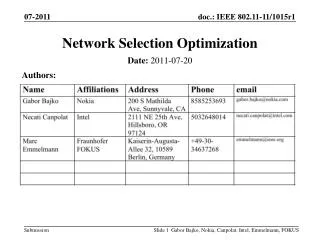
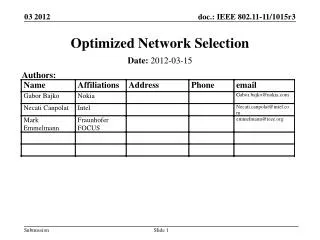
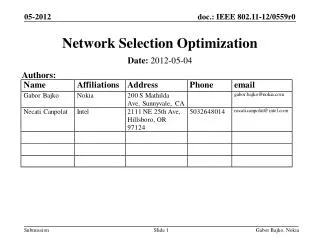
Network Selection Optimization Authors: Date:2012-05-04 Gabor Bajko, Nokia
Abstract Currently, STAs do Network Discovery by sending unicast GAS requests to APs this mechanism is very inefficient and time consuming, as shown in 11-1015r2 Prior to Network Discovery, STAs have to perform scanning, to learn the MAC address of the candidate APs. Most STAs on the market perform active scanning to save time. Therefore, a STA ends up in most cases transmitting a broadcast Probe Request, followed by unicast GAS requests to all APs; this process is time consuming and wastes radio resources This submission proposes to combine Probe request and GAS Requests Gabor, B. and Canpolat, N.
The time consuming aspect of the current Network Discovery procedure was documented in 11/1015r0 and its revisions, and discussed extensively in the TG A broadcast based GAS request proposal was presented,however, it resulted in a discussion on combining GAS request with Probe Request. There was one concern expressed for combining Probe Response with GAS Response, that a long GAS Response frame may not fit in a Probe Response frame Prior discussions John Doe, Some Company
Combine Probe Request with GAS Request by including GAS RequestIE into the Probe Request • Define a possibility to combine Probe Response with GAS Response • If the GAS Response frame is too long, or not immediately available indicate in the Probe Request that a separate GAS Comeback Request Mechanism could be used to pull the responses from the AP. Otherwise include the GAS Response into the Probe Response Proposal John Doe, Some Company
Add the following text to section 6.3 of the SFD For faster network discovery, STAs may combine Probe Requests and GAS Requests. AP STAs may combine Probe Response and GAS Response frames Motion John Doe, Some Company