The Election of 1800 and Manifest Destiny: A Turning Point in American History
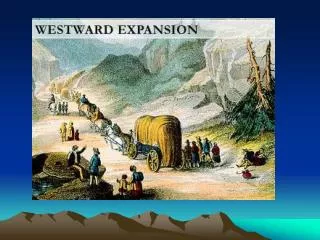
The illustration highlights significant events in early U.S. history, focusing on the Election of 1800, where Thomas Jefferson defeated John Adams, marking the first peaceful transfer of power between political parties in the nation. This election signified the shift from Federalist to Democratic-Republican leadership. Additionally, it portrays the 19th-century belief in Manifest Destiny, the idea that the U.S. was destined to expand westward across North America. Key examples include the Louisiana Purchase, Texas Annexation, and the Oregon Territory, which significantly shaped the country's borders.

The Election of 1800 and Manifest Destiny: A Turning Point in American History
E N D
Presentation Transcript
Describe what this illustration is portraying. Use 9 - 10 sentences.
Election of 1800 • President – Thomas Jefferson • Vice President – Aaron Burr • Significance – first peaceful transfer of power from one political party to another (from Federalist to Democratic-Republican)
Manifest Destiny • The 19th century belief that the United States would inevitably expand westward to the Pacific Ocean and into Mexican territory. U S A
Examples of Manifest Destiny • Oregon Territory • Mexican Cession • Gadsden Purchase • Revolutionary War • Louisiana Purchase • Adams-Onis Treaty (FL) • Texas Annexation
5 2 1 6 3 4 7
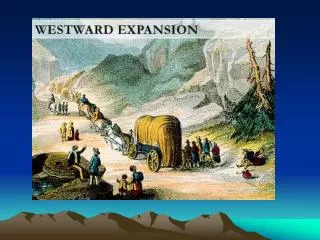
Westward Expansion • After the Revolutionary War America won the right to EXPAND • Claimed the land between the Appalachian Mountains and the Mississippi River • Doubled the original size of the colonies
Louisiana Purchase • President Jefferson bought the Louisiana Purchase from FRANCE in 1803 • Doubled the size of the United States AGAIN (530 million acres for 3¢ an acre - about $15 million)
Adams Onis Treaty (1819) • Hundreds of runaway slaves escaped to Spanish controlled Florida • U.S. received the Spanish Cession (Florida) by agreeing to pay $5 million to Americans – a debt owed by the Spanish government
Texas Annexation (1845) • Mexican gov’t allowed American settlers in Texas • Overpopulation led to laws on American settlers • Slavery outlawed = dispute • Texas declared independence as the Lone Star Republic • Battle of Alamo – Santa Anna • The U.S. added Texas as a state 10 years after its independence from Mexico
Oregon Territory (1846) • 1818 – U.S. and Great Britain agreed to joint-occupation or shared ownership of the Oregon territory • U.S. signed a treaty with Great Britain after 28 years of joint-occupation • U.S. – southern half • Britain – northern half • “54-40 or Fight” – Oregon Treaty gives US Oregon at 49 parallel
Mexican Cession (1848) • Admitted Texas as a state angered the Mexican gov’t • U.S. established boundary at the Rio Grande River and Mexico claimed it along the Nueces River • Dispute led to the Mexican War • Treaty of Guadalupe-Hidalgo • U.S. defeated Mexico and paid $15 million dollars for the Mexican Cession
Gadsden Purchase (1853) • Congress was studying possible routes for a transcontinental railroad • Proposed – a southern route from New Orleans to California • U.S. paid Mexico $10 million for the Gadsden Purchse for a level route for a transcontinental railroad
Explorers • Acquiring new lands led to the need to explore the possible use of lands • Lewis & Clark • Zebulon Pike
Expedition of Lewis & Clark • 1804: Meriweather Lewis & William Clark explored the Louisiana Territory • MAIN PURPOSE = gather INFORMATION • search for a water route to the Pacific • Establish friendly relations and trade with the Natives
Lewis & Clark • Guide: French-Canadian Toussaint Charbonneau and his wife SACAGAWEA • 1806:Lewis and Clark returned to St. Louis • Traveled 8,000 miles in 2 years
Zebulon Pike • 1805: Recorded the geography of the Mississippi River • 1806: Hired by President Jefferson to follow the Arkansas River west to its source and return by the Red River
Took detailed notes about geographical structure and population • NOVEMBER – reached the Rocky Mountains Pike’sPeak