Understanding the Discriminant in Quadratic Equations and Its Impact on Solutions
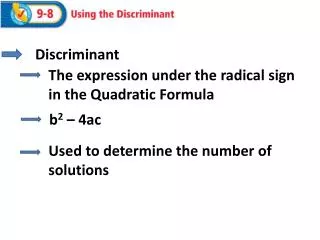
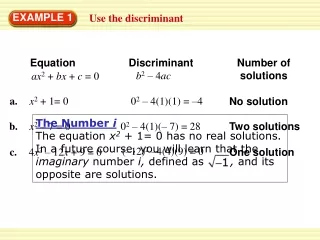
The discriminant, found under the square root in the quadratic formula, is crucial for determining the nature of solutions to quadratic equations. It can be positive, negative, or zero, leading to different types of solutions: two distinct real solutions, two complex conjugate solutions, or one repeated rational solution. For example, the equation 6x² + 5x + 1 = 0 yields two rational solutions, while x² + 4x + 5 = 0 yields complex conjugates. Understanding the discriminant provides insights into the set of possible solutions to any quadratic equation.

Understanding the Discriminant in Quadratic Equations and Its Impact on Solutions
E N D
Presentation Transcript
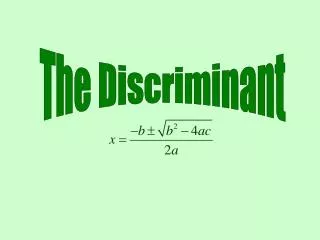
The "stuff" under the square root is called the discriminant. This "discriminates" or tells us what type of solutions we'll have. If we have a quadratic equation and are considering solutions. It is sometimes enough to know what type of number solution it will be. Using the quadratic formula, one of three things can happen. • The "stuff" under the square root can be positive and we'd get Two different real-number solutions. Solutions are rational. Solutions are irrational conjugates
Example Solving 6x² +5x +1 = 0 gives the solutions -⅓, and -½ Solving x² +4x +2 = 0 gives the solutions -2 + √2 and -2 - √2
The "stuff" under the square root can be negative and we'd get Two complex solutions that are conjugates of each other. Example Solving x² + 4x + 5 = 0 gives the solutions -2 + i and 2 – i.
The "stuff" under the square root can be zero and we'd get One solution (called a repeated or double root because it would factor into two equal factors, each giving us the same solution). Example: When b² -4ac simplifies to 0, it doesn’t matter if we use + √b²-4ac or -√b² -4ac; we get the same solution twice. Thus, when the discriminant is 0, there is one repeated solution and it is rational Solving 9x² + 6x + 1 = 0 gives the (repeated) solution -⅓.