Download
1 / 14
140 likes | 254 Vues
Discover the fascinating characteristics of the solar system, the vastness of space, and the unique features of each planet. From the scorching heat of Venus to the icy realms of Neptune, learn about the number of moons, day lengths, year spans, and atmospheric conditions for each celestial body. Delve into the mysteries of the Sun, the largest star, and observe how the planets orbit in harmony. This engaging overview provides valuable insights for astronomy enthusiasts and curious minds alike!

E N D
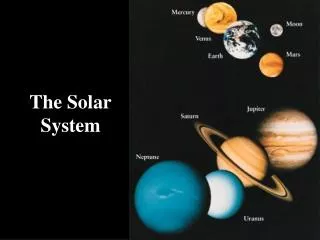
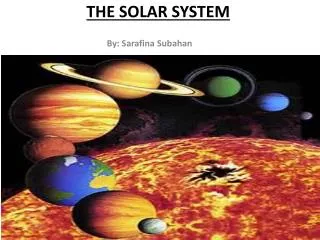
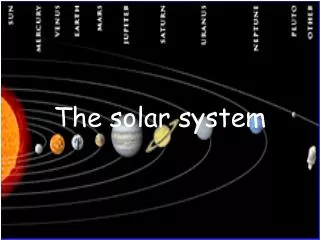
SUN • A star • Largest thing in our solar system • Made of hydrogen & helium
Mercury • 0 moons • Temperature during the day is 870° F and at night –300°F • 1 day = 59 Earth days • 1 year = 88 Earth days
VENUS • Hottest planet in the solar system– average temperature is 850°F • 1 day = 243 Earth days • 1 year = 225 Earth days
EARTH • 1 moon • 93 million miles from the sun • 1 day = 24 hours • 1 year = 365 days
MARS • 2 moons • Temperature ranges from 98°F to –190°F • 1 day = 24 Earth hours • 1 year = 687 Earth days
JUPITER • 28 moons • Largest planet • “Great Red Spot” is a storm like a hurricane • 1 day = 10 Earth hours • 1 year = 4333 Earth days
SATURN • 30 moons – more than any other planet • Known for its rings • 1 day = 10 Earth hours • 1 year = 10,759 Earth days
URANUS • 21 moons • Spins on its side • 1 day = 17 Earth hours • 1 year = 30,684 Earth days
NEPTUNE • 8 moons • Has a “Great Dark Spot” which is a storm • 1 day = 16 Earth hours • 1 year = 60,190 Earth days
PLUTO • 1 moon • Smaller than 7 moons in the solar system • 1 day = 6 Earth days • 1 year = 90,465 Earth days
Resources • http://www.nineplanets.org/ • http://www.solarviews.com/ • http://science.nasa.gov/headlines/y2005/29jul_planetx.htm • http://www.kidsastronomy.com/ • Video - http://www.unitedstreaming.com/ • Music - http://www.elite.net/~gurpal/movie1.htm • Frank, Marjorie, Slavick, Jones, Robert M. Etc. Science. Harcourt School Publishers, 2000, pgs. D54 – D87.