Download
1 / 8
80 likes | 199 Vues
This document outlines the Italian experience in combining survey and administrative data within the EU-SILC framework, focusing on both positive and critical aspects. It discusses the methodology of sample design, survey techniques, and the integration of administrative data such as population and tax registers to improve data quality. Key components include the use of rotational sampling, data editing processes, and the impact of these approaches on statistical accuracy, completeness, and longitudinal consistency. Future developments aim to enhance these methodologies for better data quality.

E N D
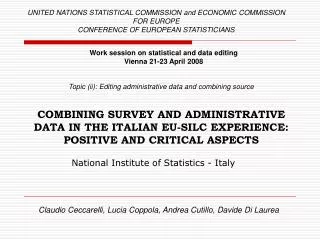
UNITED NATIONS STATISTICAL COMMISSION and ECONOMIC COMMISSION FOR EUROPE CONFERENCE OF EUROPEAN STATISTICIANS COMBINING SURVEY AND ADMINISTRATIVE DATA IN THE ITALIAN EU-SILC EXPERIENCE: POSITIVE AND CRITICAL ASPECTS Work session on statistical and data editing Vienna 21-23 April 2008 Topic (ii): Editing administrative data and combining source National Institute of Statistics - Italy Claudio Ceccarelli, Lucia Coppola, Andrea Cutillo, Davide Di Laurea
Eu-Silc and It-Silc • Main aims • collecting a large set of qualitative and quantitative data at individual and household level • providing cross and longitudinal data for measuring income and living condition • Sample design in Italian Eu-Silc (It-Silc) • adopting rotational sampling design composed of 4 rotational sub-samples • each sub-sample to be followed-up during 4 years • Survey techniques in It-Silc • adopting PAPI strategy with interviewer
Administrative data in It-Silc To improve data quality, It-Silc uses: • Population register (PR) • to provide correct identification to trace sample units in order to reduce the effect of attrition • in calibration estimators • Tax registers (TR) • to reduce or remove selective non-response and memory effect and/or telescoping • to reduce total non-response effects
Tracing rules and population register • Define target population • draw initial sample from register of sampling municipalities • During the fieldwork • PR used to combine sample information about household and individuals • After fieldwork completion PR used • to integrate incomplete information carried-out from each waves of survey • to control the cross sectional and longitudinal consistencies about demographic variables
Tax registers and survey data • Main steps of the integration process • Performed at the micro-level (exact matching technique) with survey data • Harmonization: sources have ≠ concepts, definitions and classifications for income Example: cooperatives members do perceive • dep. work income for Italian fiscal rules • self-employment income according to EU-SILC regulations • Complex statistical data editing to make data consistent: • Income components for year t-1 from the two sources • ILO and self-defined Status in employment in time t • Choice of the pertinent income value
Administrative data and total non response • Population and tax registers to reduce the effect of non response • Segmentation method by CHAID algorithm • Better accuracy of the estimates does not imply greater variability in respect of stratum correction • Characteristics from population register: demographic size and territorial domain of the municipality; household size and household head nationality • Tax registers: type and amount of income • Important issue in Italy: tax avoidance more frequent in particular sub-groups
Remarks • Positive aspects • accuracy • completeness • comparability • macro-level cross and longitudinal coherence • Critical aspects • micro-level longitudinal consistency • timing for accessibility of tax register imply decrease of timeliness
Future developments • Longitudinal checks of tax registers to increase micro-level longitudinal consistency • Add new rules in cross-sectional editing to increase longitudinal data quality • Introduce selective/macro editing methods to control large variations in cross-sectional data and particular transitions in different waves