Download
1 / 24
240 likes | 347 Vues
This project presents the design and development of a rocket motor system incorporating a highly efficient fuel grain made of R-45M resin, cross-linked with diisocyanate. Key components include a lightweight 6061-T6 aluminum motor housing, a high-temperature ceramic composite nozzle, and an ignition system optimized for reliability. The motor is static-tested to 1200 psia and designed for a maximum altitude of 10,641 feet AGL with a burn time of 5.4 seconds. Safety protocols for fuel mixing, including dry and liquid chemicals, ensure optimal performance and minimize risks.

E N D
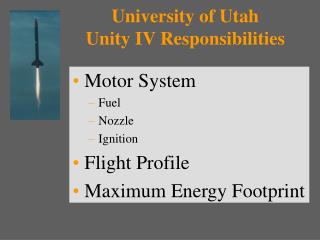
University of Utah Unity IV Responsibilities • Motor System • Fuel • Nozzle • Ignition • Flight Profile • Maximum Energy Footprint
Motor System • Fuel • HTPB: Fuel grain composed of R-45M resin • Cross- linked with diisocyanate • Motor Housing • 6061-T6 Aluminum • Static tested to 1200 psia • Nozzle • Ceramic Composite • Rated to 5000 F
Ignition • Model Rocket Motors • 2, Estes C8-0 motors • Accessible on Launch Rail • Low power requirement • 4 AA Batteries • Reliable Performance
NO2 inlet “O” Ring Seal Estes C8-0 Motor Injector HTPB HTPB Motor Cap Assembly
Flight Profile • Maximum Altitude • 10,641 feet AGL, at T = 28 seconds • Burn Time • T = 5.4 seconds • Flight Velocity • Launch Rail Exit = 89.1 ft/s • Overall Flight = 0.71 Mach • FTS Failure Impact • 763 ft/s at T=58 seconds
Maximum Energy Footprint • 5.40 Miles at q0=450 • No Critical Areas with in Range
Fuel Mixing Procedure • Safety Equipment • Liquid Chemicals • Incorporate By Hand • Dry Chemicals • Incorporate By Hand • Mix For 30 Minutes
Fuel Mixing Problems • Need More Mixing Time • Recipe • Catalyst