Download
1 / 19
190 likes | 294 Vues
The Kuopio National Library, established in 1989 and part of Norway's reorganized National Library, serves as a hub for bibliographic services and cultural programs. With a collection exceeding 1 million books, journals, films, and sound recordings, the library has faced challenges, including the transition to an automatic storage system to enhance efficiency. The library's future focuses on improving internal cooperation, expanding document selection, and promoting Norwegian music and multimedia, ensuring it remains a vital resource for the community.

E N D
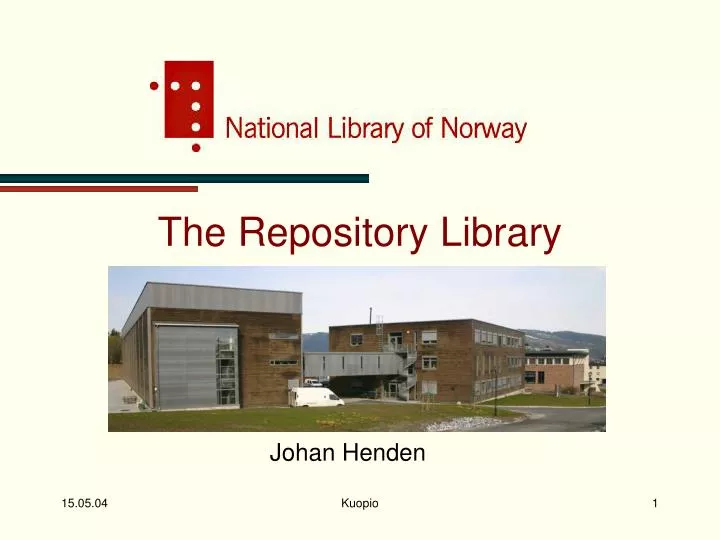
The Repository Library Johan Henden Kuopio
Background • The Re-organised National Library 2004 • One organization - two sites: • Oslo 150 employees • Mo i Rana 200 employees Kuopio
Organisation • National Librarian • Assistant National Librarian • 7 directors • 5 divisions Kuopio
Divisions • Collections and bibliographic services • Information technology • Culture and public programmes • Media conservation • Administration Kuopio
Historical outline • Oslo est. 1811 as university library. • 1814 combined university- and national library • 1989 National library division in Rana • 1999 Oslo separated from the university – hence National Library with two divisions Kuopio
Rana division • Established 1989 • Legal deposit dept • Media laboratory • Sound and image archive • Repository library • Administration, technical unit and ITdept. Kuopio
Rana division (2) • 350 000 volumes of legally deposited books and journals security stored • 1 000 000 books and journals for lending • 70 000 volumes of newspapers • 50 000 films • 50 000 sound recordings • 1 100 000 photographs • 200 000 tapes from broadcasting Kuopio
The Repository Library • Established 1989 • Collections consisting of legal deposited documents ca 30 000 volumes annualy • low demanded documents transferred from the entire Norwegian library community ca. 30 000 – 90 000 volumes annualy Kuopio
1990-2001 • Effective lending service • Greater influx of documents than expected • High level cataloging in Bibsys • Consequence. A large backlog in cataloging and processing Kuopio
Types of documents and services • Monographs – lending • Periodicals – copies • Microfilmed newspapers – lending • Surplus document service – copies supplied to other libraries Kuopio
1990-2001 • In 1995 a new store with moving shelves was built (unfortunately too small) • Long term planning to increase the storage capacity commenced immediately. Several different alternatives were considered • In 2000 an automatic storage system was chosen and building commenced Kuopio
Structure • Swisslog lwas chosen as the supplier • Communication between Swisslog and Bibsys • WMS Warehouse management system Kuopio
Transition process • A project was established for the transition to an automatic storage system • Resources were reallocated and numbers of personell were temporarily increased • Regular lending services were suspended Kuopio
Transition challenges • 1 million books, periodicals and microfilms had to be moved • 3 500 shelf meters of periodicals had to be catalogued • 41 000 storage boxes containing 1 million folders containing 1 million items had to be placed in the automatic store • 12 000 shelf meters of moving shelving had to be dismantled • Communication between Bibsys and Swisslog had to be established Kuopio
Consequences • Previously uncatalogued documents were catalogued • Cataloguing routines were simplified • Collection development was improved Kuopio
Advantages • Spacesaving storing and effective retrieval • One quarter of the storage space needed compared to traditional shelf storing • Optimized collection development Kuopio
Objections • Noise • Tedious work • Less variation in daily routines • New technology Kuopio
Some experiences so far… • Increased demand for loans • Better collection management • Items most in demand are placed at the front Kuopio
The future • Internal cooperation in the National Library • Extended document selection • Purchasing policy • Audiobooks • Norwegian music • Norwegian moving pictures Kuopio