Download
1 / 12
120 likes | 243 Vues
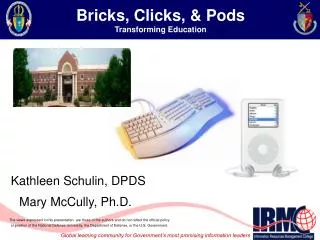
This conversation highlights the importance of integrating technology within education, specifically the use of iPods for effective learning among students at the Information Resources Management College. It explores the outcomes of a pilot project that revealed a strong preference for audio-based learning and how these findings can inform the future of educational models. The study emphasizes the need for flexibility, interactivity, and multimedia resources to engage modern students effectively. It targets mid-to-senior-level leaders and civilians who are evolving in their learning process.

E N D
Kathleen Schulin, DPDS Mary McCully, Ph.D.
A Conversation • Relevance of Topic • Our College • Our Students • The Research • Our College’s On-Line Model • Our College’s iPod Pilot Project Research • Implications for Future
The Information Resources Management College • Global learning community • For Government’s most promising information leaders • Provides our students • Strategic leader development • Current, timely, future-focused learning • Access to learning wherever they are • Graduate and professional education
IRM College Students • Mid-to Senior Level Government Leaders • Civilians • Military Officers • Multi-agency • International - Coalition Partners • 20 – 30 years work experience • Baby Boomers • Generation Xers
Evolution of Technology Enabled Learning (Literature Search) • Mail-in technical training • Text based correspondence course • Satellite broadcasts • Web-based e-learning • E-learning integrated with traditional “bricks” classroom • Multi-media within “Bricks” and “Clicks”
Students Say They Don’t Want • E-correspondence course • Significantly more work • Print out everything • Stealth faculty • Substandard course Want • Participation flexibility • Interactivity (content & peers) • Networking • Trust & Non-attribution • Spontaneous social interaction • On-demand review of course content • Dynamic multi-media • Build professional library • Options: clicks & bricks n = 273 students 14 courses
Planning Expectations Personalization Expertise Immersion Interaction An On-Line Model P I E
Learning With Mobile Audio University of Michigan School of Dentistry Drexel College Duke University Bentley College Purdue University
Methodology • 188 students • 12 e-resident offerings • 14 months Oct 04 – Dec 05 • 1 week each offering • 12 of 54 course readings “read” • Locked audio iPods • 1st day technology familiarization • 19 item survey last day • 16 Likert questions • 3 open-ended • 89% students completed survey National Defense University Information Resources Management College Pilot Project H0: IRM College students will take advantage of listening to learn H0: IRM College students can learn by listening H0: IRM College students want to continue to listen to learn
Research Findings • 71% students recommended other courses integrate audio material • 72% students want to down-load audio onto their devices • Leaders Can Learn by Listening • Leaders Can and Will Learn on the Go • Leaders Want to Listen to Learn
Research Findings • Students said • 72% - iPod Easy to Use • 75% - “Readings” Easy to Find • 73% - Orientation Session Valuable • 84% - Readings Clear & Understandable • 72% - Readings Easy to Follow • Previous Experience • 35% - iPods or MP3s • 48% - Books on CD or Tape iPod User Friendly for Educational Listening
Conclusion • Educators in early stages of discovering how to leverage technology to support learners • Today’s life-long learners • Tech-savvy multi-taskers • Want & need active learning • Want & need diversity of pedagogy • Ready, willing & desirous of leveraging technology for learning • Want the option to listen to learn • Want flexibilityin technology mode • Leaders given the opportunity – reported positively on iPods tool for learning