Download
1 / 7
70 likes | 176 Vues
Learn how to convert quickly between rectangular and polar coordinates for surveying purposes. Calculate distance and bearing between points using Easting and Northing coordinates. Understand the importance of order in point placement.

E N D
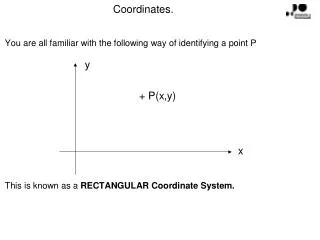
Another way of identifying the same point P is y u +P ( r , ) r u x This is known as a POLAR Coordinate System.
FOR SURVEYING we use a slightly different form of notation ... instead of x,y we use E,N ( Easting, Northing) N +P ( E ,N) u • D E
N.B. Easting is always quoted first and then Northing . u is always measured in a CLOCKWISE direction from North. u is known as the WHOLE CIRCLE BEARING. (WCB) We MUST be able to Convert from Rectangular to Polar VERY QUICKLY. (and from Polar to Rectangular)
N N Q u u PQ QP P We consider that the line PQ is a different line to line QP Any line has two bearings
Given the co-ordinates of two points, calculate the distance between them and the Q N bearing of the line joining them. u P PQ The order of the points is very important: We begin at P and move to Q P is the NEAR POINT, with co-ordinates NearE, NearN And Q is the FAR POINT, with co-ordinates FarE, FarN For line PQ
1. Difference in Northings: FarN - NearN 2. Difference in Eastings: FarE - NearE Your calculator gives two answers :- 1. Distance P to Q (in metres) 2. Bearing P to Q (if this is negative, add 360o) (Depending on your calculator, you may have to convert the bearing to degrees, minutes and seconds)