Calculation of Dihedral Angle Using different Basises
This study examines the dihedral angle, the angle formed by two intersecting planes, and its significance in molecular conformation, particularly for the molecule C14H20N2. Using various basis sets, we analyze how changes in the dihedral angle influence the HOMO-LUMO energy gap. Calculations were performed using minimal basis HF and 6-31G** methods. Our findings reveal that the dihedral angle can be defined more accurately with better basis sets and significantly affects the HOMO-LUMO gap, highlighting the importance of computational methods in understanding molecular geometry.

Calculation of Dihedral Angle Using different Basises
E N D
Presentation Transcript
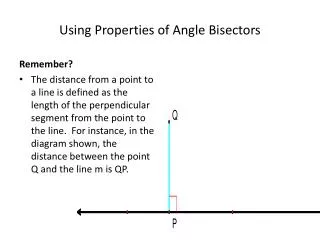
Dihedral angle • The angle created by two intersecting planes
Importance of dihedral angle Conformation
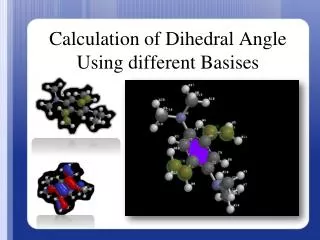
Molecule of Interest C14H20N2
1. Change in dihedral angle Minimal basis HF 139.95
6-21 G HF 120.60
6-31G* HF 116.34
6-31G** HF 116.11
6-31+G* HF 118.50
Comparison Dihedral angle Basis set
116.11 139.95 Minimal basis HF 6-31G**
HOMO LUMO Minimal basis 6-31G**
Density distribution on HOMO and LUMO HOMO LUMO Minimal basis 6-31G**
2.HOMO LUMO ENERGY GAP Energy Gap (eV) Dihedral Angle
Conclusions 1. Dihedral angle became defined with better basis sets. 2. Change in dihedral angle effects the HOMO - LUMO gap of the molecule.
Reference 1.http://www.structuralbioinformatics.com/chapter7.shtml 2.http://www.cartage.org.lb/en/themes/Sciences/Chemistry/Org anicchemistry/Common/Common.htm. 3. Organic Chemistry, William H. Brown, Christopher S., Foote Brent L. Iverson 4. A brief guide to Molecular Mechanics and Quantum Chemical calculations , warren J. Hehre, Jianguo Yu, Philip E. Klunzinger, Liang Lou.