CORE PRINCIPLES
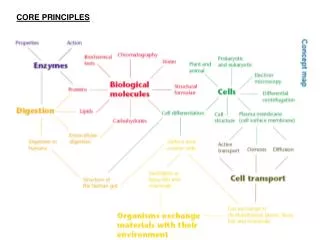
Organisms exchange materials with their environment mainly through diffusion, which becomes inefficient for larger organisms due to low surface area to volume ratios. Specialized exchange surfaces have evolved, enhancing diffusion rates. For instance, mammals use alveoli in lungs, bony fish utilize gill plates, and plants rely on mesophyll cells in leaves. Effective exchange surfaces possess large areas, thin walls, and steep concentration gradients. Additionally, the digestion process involves adaptations in the gut and enzymatic activities, leading to efficient nutrient absorption.

CORE PRINCIPLES
E N D
Presentation Transcript
ORGANISMS EXCHANGE MATERIALS WITH THEIR ENVIRONMENT • Exchange is mainly by diffusion • Diffusion over the surface of a large organism is inefficient - small surface area :volume ratio • Larger organisms have specific systems containing exchange surfaces. • These exchange surfaces are adapted to speed up diffusion
Exchange Surfaces • Mammals – alveoli • Bony fish – gill plates on the lamellae • Dicotyledonous plant leaves – mesophyll cells
Good exchange surfaces have: • A large surface area – increases the SA:volume ratio • A thin surface – a shorter distance to travel • A steep diffusion gradient – a greater difference in concentration increases the rate of diffusion – more molecules cross the surface per unit of time
Mammals - the lungs remove about 5% of the total oxygen in the air.ALVEOLI provide a good exchange surface A large SA – branched bronchioles millions of alveoli each alveolus is folded A thin permeable surface – flattened cells of alveolus & capillary walls two surfaces next to each other A diffusion gradient – blood carries gases to & from the surface ventilation brings air into & removes air from the alveoli
Bony fish – gills remove 80% of the total oxygen in waterGILL PLATES are ideal gas exchange surfaces A large SA – 4 pairs of gills with lamellae & gill plates A thin permeable surface – surface of the gill plates & capillary wall made up of flattened cells total distance for diffusion 5um A diffusion gradient - circulation of the blood & ventilation counter current flow lamellae held apart by water
Plant leaves – the large number of leaves contribute to the gas exchange surface MESOPHYLL CELLS A large surface area – each leaf is flat mesophyll cells separated with large air spaces between them A thin permeable membrane – rarely more than 10 cell layers from top to bottom of a leaf to enter cells , gases only have to cross a cell wall & cell surface membrane A diffusion gradient – mesophyll cells use the gases for biochemical reactions
Need to Know Ventilation of the lungs • pathway of the air • volume & pressure changes • structures involved Ventilation of the gills • counter current flow • volume & pressure changes • structures involved
Digestion The structure of the gut wall – 3 main layers
Adaptations Oesophagus • quick passage of food Stomach • temporary storage • mixing of contents • some digestion Duodenum & ileum • Digestion • absorption
Enzyme activity - carbohydrate digestion • Involves mouth, pancreas & small intestine
Enzyme activity - protein digestion • Involves stomach, pancreas & small intestine
Enzyme activity - lipid digestion • Involves the pancreas & bile activity
Absorption • Glucose & amino acids absorbed into blood capillaries partly by facilitated diffusion & partly by active transport • Fatty acids & glycerol absorbed into the lacteals & the blood capillaries by simple diffusion
& finally Testing for carbohydrase activity • Starch-agar plates can be used to look for carbohydrase activity • The size of the colourless area gives an indication of the activity of the enzyme • The larger the colourless area, the more active the enzyme