
Fluid Compartments and Balance in the Body: Regulation and Measurement
E N D
Presentation Transcript
Body Fluids Ref: Textbook of Medical Physiology Guyton and Hall, 12th Edition Pages: 285-297
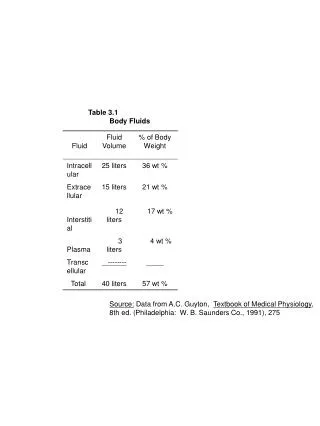
Water Distribution • Synovial • Pericardial • Pleural • Peritoneal • Ocular • Cerebrospinal Transcellular Fluids
Movement of Fluids between Compartments Major factors that regulate movements: - Osmotic pressure - Hydrostatic pressure
Water and Electrolytes Homeostasis Systems involved in the regulation of fluids and electrolytes - Kidneys, - Cardiovascular system, • Endocrine (Pituitary, Parathyroids, Adrenal glands) • Lungs
Movement of Fluids between Compartments Major factors that regulate movements: - Osmotic pressure - Hydrostatic pressure
Regulation of Na+ and Water • Osmolality • Volume of ECF different regulations with many overlapping mechanisms. Involves regulation of:
Measuring Body Fluids Dilution Principle
Properties of tracers used for calculation of volumes • Properties of an Ideal Tracer The tracer should: • be nontoxic • be rapidly and evenly distribute throughout the nominated compartment not enter any other compartment. • not be metabolized. • not be excreted (or excretion is able to be corrected for) during the equilibration period • be easy to measure • not interfere with body fluid distribution
Measurement of Total Body Water * Radioactive water (3H2O, Tritium) or heavy water (2H2O, Deuterium). This will mix with the total body water in just a few hours and the dilution method for calculation can be used. * Antipyrine
Measurement of ECF volumes • 22Na+, (Sodium Space) • 125I-iothalamate, • Thiosulfate, • Inulin (Inulin Space) (Measured in 30-60 minutes)
Calculation of ICF (Intra- Cellular Volume) ICF= Total Body water - ECF
Measurement of Plasma volumes Measurement of Total Blood Volume
Plasma Composition • Water: > 90% • Small molecule: 2%, it is electrolytes, nutriment, metabolic products, hormone, enzymes, etc. • Protein: 60-80 g/L, plasma protein include albumin (40-50 g/L)(54%), globulin (20-30 g/L,α1-, α2, β-, γ- ) (38%)and fibrinogen (7%). Most of albumin and globulin made from liver.
Measurement of Plasma volumes Measurement of Total Blood Volume * 51Cr-labeled Red Blood Cells*Calculated As = Plasma Volume1-Hematocrit * 125I-Albumin (RISA), * Evans Blue (Dye (T1824))