Understanding Congruent Triangles and Polygons
This resource discusses the concept of congruence in geometry, focusing on triangles and polygons. It explains that two polygons are congruent if their corresponding parts—vertices, angles, and sides—are congruent as well. The text provides guidance on naming congruent polygons and how to prove that two triangles are congruent by showing that their corresponding sides and angles are equal. It references homework assignments and examples for practice, emphasizing the importance of understanding congruent angles and triangles in the context of geometric proofs.

Understanding Congruent Triangles and Polygons
E N D
Presentation Transcript
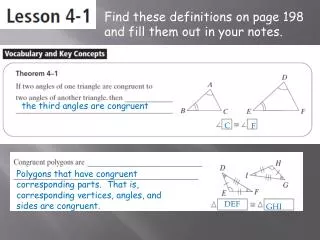
Find these definitions on page 198 and fill them out in your notes. the third angles are congruent C F Polygons that have congruent corresponding parts. That is, corresponding vertices, angles, and sides are congruent. DEF GHI
When you name congruent polygons, always list corresponding vertices in the same order. T C BC QJ
Read through the example on the top of page 199 and then fill in the blanks below. 180 m<M 48 48 67 115 65
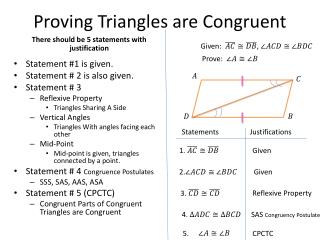
Proving Triangles Congruent • We are able to conclude that two triangles are congruent if their corresponding sides and corresponding angles are congruent to each other.
Now read through Example 3 on pg. 199 <DCE <DEC Is NOT DE DC EC <DEC <CDE <ACB ABC EDC
Oh YEAH? Prove IT! Given • Reflexive Given Definition of perpendicular lines. All right angles congruent. <CGN congruent to <DGN congruent. 4-1 congruent.
On Your Own for this one: Given Theorem 4-1 – If 2 angles are congruent in 2 triangles, then their 3rd angles are congruent. <ABE congruent to <DBC Given Definition of congruent triangles
Homework • Geometry 1st and 3rd period • Practice 4.1, pg. 201, 16, 18, 32, 34 • Honors Geometry 5th period • Practice 4.1, pg 201, 16, 18, 32, 34, 44