Strata Managers: Evolving Educational Standards and Their Impact on Licensing in Australia
This research paper examines the evolving educational requirements for strata managers in Australia from the mid-1990s to the present. It argues that educational standards from the 1990s better served consumer needs than the current standards imposed since 2005. The paper outlines a methodology which includes analyzing changes in national training packages and assessing course content delivery across registered training organizations. It highlights discrepancies between recommended and actual delivery hours, questions the efficacy of existing educational frameworks, and emphasizes the need for further research.

Strata Managers: Evolving Educational Standards and Their Impact on Licensing in Australia
E N D
Presentation Transcript
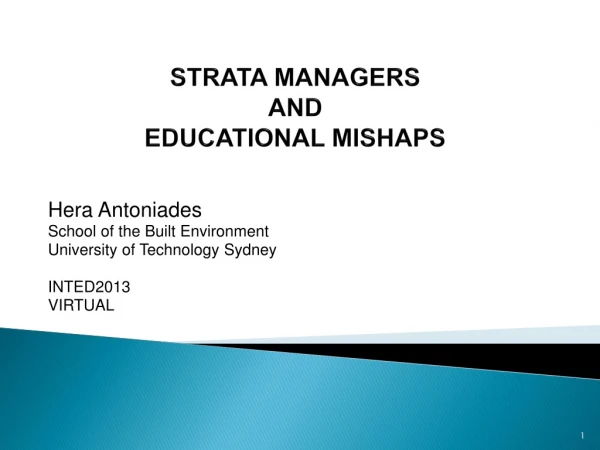
STRATA MANAGERS AND EDUCATIONAL MISHAPS Hera Antoniades School of the Built Environment University of Technology Sydney INTED2013 VIRTUAL
PURPOSE OF THE RESEARCH PAPER Examine the minimum standards of education and knowledge, which are imposed as a pre-requisite for the licensing of a Strata Manager. It is argued educational requirements during the mid 1990’s to the early 2000’s best served the needs of the consumer in comparison to these last 10 years.
METHODOLOGY and LIMITATIONS • FIRST STAGE • Collate the historical changes since 2005 – national training packages commencement date - which are relevant to education for the property licence. • Map course content for the current course against the role of the strata manager. • SECOND STAGE • Randomly select 5 registered training organisations to verify if the mandated property courses were adequately delivered to the students. Data in the second stage will include course content and hours allocated for the delivery of the course. Data from stages one and two is tabulated and compared to the national training package
TABLE 1: CHRONOLOGICAL DEVELOPMENT OF LICENSING COURSE FOR STRATA MANAGERS Source: Training packages from the Construction and Property Services Industry Skills Council and TAFE NSW.
TABLE 2: Course content Source: Property, Stock and Business Agents (Qualifications) Order 2009
TABLE 3: Actual hours v. Nominal hours Source: Web sites for RTOs accessed 20th December 2012
CONCLUSION • Course content is adequate and compares favourably with the requirements and knowledge aligned to a Strata Manager. • The delivery of the educational requirements by the Registered Training Organisations is questionable. The nominated hours of 590 recommended in the training packages is not evident with the delivery hours allocated by the RTO’s. • Therefore, due to the huge discrepancy between the nominal hours and the actual hours allocated to the educational course, further research is necessary.
FURTHER RESEARCH • If the RTOs have reduced the number of hours to deliver an educational course which sits within Australia’s VET quality control framework, are there processes to monitor the academic rigour that might be compromised? • Should the government continue with national training packages and compulsory education for occupational licensing? • Are there any differences between a government RTO and a private RTO with regards to the delivery of the course and the hours actually allocated for the various subjects and the application of the RPL?