Mastering Regular Expressions: A Deep Dive with Danny Bryant from the City of Atlanta
Join Danny Bryant, IT Manager and a prominent figure in user groups such as ODTUG, OAUG, and IOUG, as he explores the fascinating world of Regular Expressions (RegEx). This session covers the basics of pattern matching, META characters, and the power of RegEx functions within SQL. Gain practical insights on how to utilize RegEx for data manipulation and query optimization. Whether you're a novice or an experienced user, you'll discover a love/hate relationship with this powerful tool that enhances your search capabilities in Oracle databases.

Mastering Regular Expressions: A Deep Dive with Danny Bryant from the City of Atlanta
E N D
Presentation Transcript
Regular Expressions Danny Bryant City of Atlanta 101
About the Presenter Danny Bryant IT Manager, Sr.- City of Atlanta User Groups: ODTUG | OAUG | IOUG Publications & Media ODTUG (blog) – How’d You First Get Involved with ODTUG? RMOUG – SQL>SELECT Regular Expressions: A Love/Hate Relationship OraclePodcast SQL Dev 4.0 in Action at the City of Atlanta @dbcapoeira dbryant@atlantaga.gov http://www.dbaOnTap.com Danny Bryant
Agenda • Simple Pattern Matching • What are Regular Expressions • META Characters • Examples • Regular Expression Function • Examples
Simple Pattern Matching LIKE Operator %(multiple characters) _ (single character)
Simple Pattern Matching LIKE Operator with ‘%” SELECT first_name, last_name FROM employees WHERE last_nameLIKE‘Ba%'
Simple Pattern Matching LIKE Operator with ‘_’ SELECT first_name, last_name FROM employees WHERE last_nameLIKE‘Ba_da’
Simple Pattern Matching What if you needed to find all words where every second character is a vowel? Regular Expressions
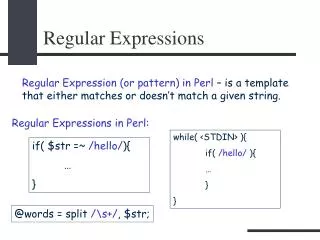
What are Regular Expressions? • Methods of describing both simple and complex patterns for searching and manipulating • Uses META Characters for pattern matching • Oracle’s implementation is an extension of the POSIX (Portable Operating System for UNIX)
META Characters Examples
Regular Expression Functions • Set of SQL functions used to search and manipulate strings using Regular Expressions • These functions can be used on any data type that holds character data (CHAR, VARCHAR, CLOB, etc) • The Regular Expression must be enclosed in single quote marks
REGEXP_LIKE Similar to the LIKE operator but allows for the use of regular expressions in matching
REGEXP_LIKE All employees first name of Steven or Stephen
REGEXP_LIKE All employees first name of Steven or Stephen
REGEXP_REPLACE Search and replace text using regular expression pattern
REGEXP_REPLACE Reformat phone number from ###.###.#### to 1 (###)-###-####
REGEXP_INSTR Searches for a string using regular expression pattern and returns the position when match is found
REGEXP_INSTR Search for addresses that don’t start with a number and list the position of the first non-alpha character
REGEXP_INSTR Search for addresses that don’t start with a number and list the position of the first non-alpha character
REGEXP_SUBSTR Searches for a string using regular expression pattern and returns the matched substring
REGEXP_SUBSTR Only return POSITION department name
REGEXP_SUBSTR Only return POSITION department name
REGEXP_COUNT Returns the number of times a pattern appears in the string. • Scenario 1: DNA sequence of a mouse. Need to find the number of times the sequence of Cytosine, Adenine, Thymine (cat) proteins occur. • Scenario 2: All rows where there is an ‘i’ in the first name
REGEXP_COUNT Scenario 1
REGEXP_COUNT Scenario 2