Advancements in High-Speed UAV Technology – Project Overview and Future Goals (2005)
This presentation outlines the High-Speed UAV project initiated by our team in Fall 2005. Led by team members Brad, Travis, and Matt, we explore the project's objectives, current progress, and future directions. Our aim is to develop a fully autonomous UAV capable of exceeding 300 mph, supported by advanced control systems and innovative airframe designs made from composite materials. We discuss customer needs, fundraising efforts, and detailed design aspects, which include aerodynamic modeling and autonomous control technologies to optimize efficiency and safety.

Advancements in High-Speed UAV Technology – Project Overview and Future Goals (2005)
E N D
Presentation Transcript
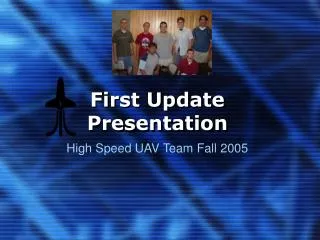
First Update Presentation High Speed UAV Team Fall 2005
Topics 1. What is our project about - Brad 2. What we have been doing? - Travis 3. Where are we going? - Matt
High Speed UAV Project Outline 1- Customer needs 2- Complete autonomous control of the aircraft 3- Build a UAV capable of 300+ mph flight speeds 4- Airframe constructed from composite materials 5- Innovative launch/ landing techniques
Customer needs- Design a small, relatively light UAV Maximum functionality for its size Could easily be carried into a location and setup for use Low cost to manufacture and assemble Autonomous control -Fly without manual controls Use preprogrammed GPS way points for flight path High Speed - Beat current record of 268 mph Target speed of 300 mph Airframe – Modify current airframe design Light weight, composite Launch landing techniques – Optimize fuel efficiency and aircraft Safety High Speed UAV Project Outline
What We’ve Been Up To Fundraising • $3200 from existing ASUU funding last year • $3000 from ATK (used to purchase controller) Only $1100 away from controller system (already a $7000 discount has been applied)
Autonomous Control System • Picolo System • Built in sensors including a Simulation Program • Requires airframe input parameters
Modeling • Fluent Analysis • A current revision • of the HSUAV • solid model from • 2003 has been • completed
Current HSUAV Designs • Excalibur TUAV • Wingspan: 8 ft. • Length: 13 ft. • Weight: 992 lb. • Flight time: 4 hrs. • Max Speed: Mach 0.71 • Shadow 200 • Altitude: 15,000 ft. • Range: 32 nm • Endurance: 4 hrs. • Cruise Speed: 84 kts. • Maximum Speed: 150 kts. • Propulsion: 37 hp • Weight: 215 lbs. • Length: 9 ft. • Wingspan: 12.75 ft.
Project Aspects Manuf. Control Design Money Testing
Design Tasks • Existing design will be analyzed using CFD, FEA and traditional techniques • Aerodynamic Parameters Extracted • All internal components (controller, hardware, turbine, fasteners will be modeled) • All parts assembled in CAD. CG and other parameters determined.
Manufacturing Tasks • Mold for Rev 2 model finished • Models created from mold • Control Surfaces Installed • Linkages, servos and hardware installed • Turbine Mounted • Landing Gear • Launch
Control Tasks Picolo Autopilot • Best Controller For our application • Gyros x, y, z • Accelerometers x, y, z • GPS • Simulation • Hefty Discount
Fundraising Tasks • Continue to speak with potential donors(Aerojet, Boeing, Northrop Grumman, ATK…etc.) • Update current sponsors with our progress. • Purchase Control unit by November.
Testing • Fluent Test • Wind Tunnel Test • Controller Simulation • Car Tow • Final Test