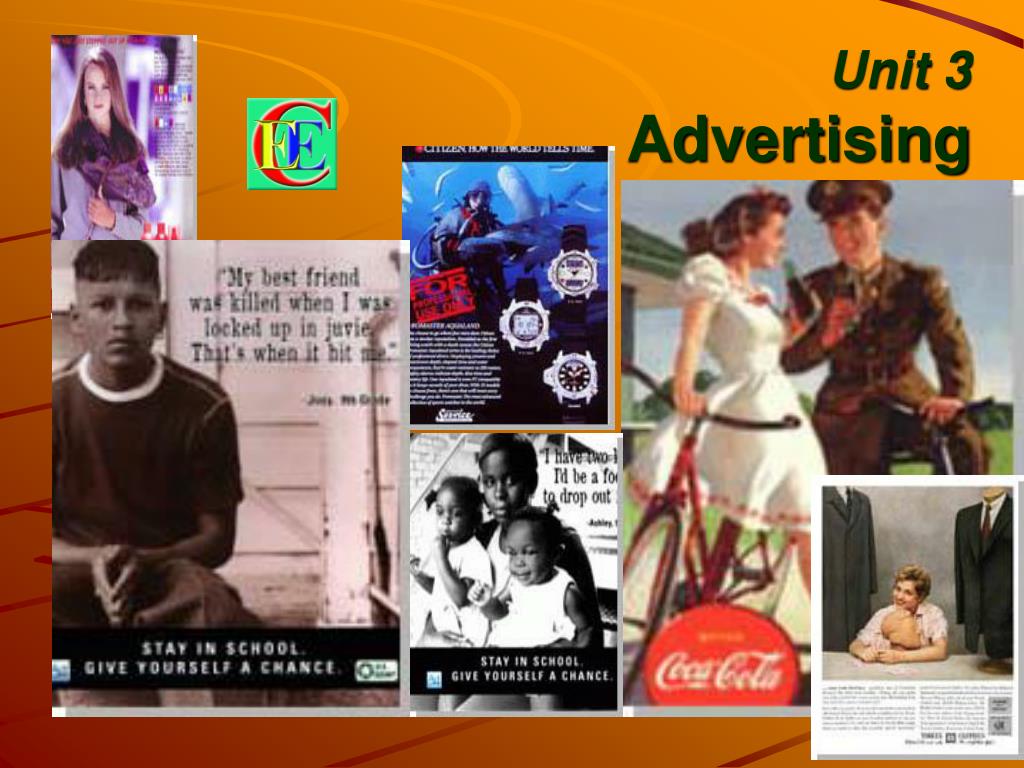
Unit 3 Advertising. Unit 3 Advertising. In this unit, you will. first listen, and then talk about the advantages and disadvantages of advertising ; read about the influence of advertising on people and the role of the Ad Council in the U. S ; learn new words and expressions
Une image / un lien ci-dessous est fourni (tel quel) pour télécharger la présentation
Politique de téléchargement : le contenu du site vous est fourni TEL QUEL pour votre information et votre usage personnel ; il ne peut être vendu, concédé sous licence ni partagé sur d’autres sites sans l’accord de son auteur.Le contenu vous est fourni TEL QUEL, pour votre information et votre usage personnel uniquement.Téléchargez la présentation en cliquant sur ce lien.Lors du téléchargement, si vous ne parvenez pas à télécharger une présentation, l’éditeur a peut-être supprimé le fichier de son serveur.Pendant le téléchargement, si vous ne parvenez pas à obtenir une présentation, le fichier a peut-être été supprimé par l’éditeur.
Unit3Advertising In this unit, you will • first listen, and then talk about the advantages and disadvantages of advertising ; • read about the influence of advertising on people and the role of the Ad Council in the U. S ; • learn new words and expressions • learn about conjunctions and connective words; • write a personal advertisement ; • visit Culture Salon for the advertising photography
Directions: Listen to the following passage and try to fill the missing words. Click here to listen. Unit3Advertising Many products for sale seem to scream at us, “Buy me! Buy me!” Advertising is a big business in our world with many products 1. _______ for our attention. Think of the last time you bought clothes. You probably noticed the 2. _______ of colors, patterns, fabric and brands you could 3. _________ from. Which kind of soft 4. _______ would you like to have today or what kind of computer do you want? Advertisers are skilled in the art of making their products look the best to appeal to our senses. But products aren’t always what they seem. Sometimes advertising is deceptive and as 5. _______, we must be careful about what we choose to buy. It is important to learn to 6. _______ products and identify our purpose in purchasing the things we need. Coupons are also a form of advertising. Sometimes fast food is tempting because a coupon is offered, even though there are more healthy choices for eating. The good thing about advertising is that it helps people to 7. _______ and refine their choices. In the United States, the Ad Council creates timely public service messages to the nation. Their purpose is to raise awareness of public problems that citizens can 8. _______ to. Inspiring ads cause individuals to take action and even save lives. 9. _______ in America, for example has been reduced over the years because of the creative Public Service advertisements that the council 10. _______. “Please, please don’t be a litter bug, ‘cause every ‘litter bit’ hurts.” Many families have taught their children to place litter in the trash can in response to this catchy phrase, which has affected generations as each succeeding generation has taught their children not to litter.
Unit 3Advertising • The photos are all related to Advertising. Describe them to your classmates with the help of the following question. • What are the pros and cons of advertising? • How does advertising influence you in your purchase decisions? • What is your opinion about the functions of public service advertisements?
Contents • Related Information • Notes to the Text • Summary of the Text • Words and Expressions • Understanding the Text
Lead-in Pictures Before reading Passage A, describe the following pictures . Ad for Coca Cola
Reference Dialogue for Task 1-Talking about a public service advertisement about waste disposal • Brian:I received an advertisement in the mail today about sorting waste products to help protect the environment.Xiaohong:I received it too. It sure sounds like a good idea - sorting out items that can be recycled, like paper, aluminum cans and plastic bottles.Brian:I've already seen the three slots that the advertisement said we should use: a blue slot for paper, yellow for aluminum cans, and brown for plastic bottles. Xiaohong:Do you think we're supposed to rinse out the cans and bottles before we put them in the slots?Brian:The ad didn't say, but I think it's a good idea since the items are going to be recycled. Well, at least that's what I plan to do.Xiaohong:Me too. Do you think other citizens will bother with this program?Brian:I certainly hope so. Everyone should be able to recognize the importance of protecting the environment. Xiaohong:You're right. Recycling these kinds of items should drastically reduce the amount of land used for waste disposal.Brian:Let's hope everyone else sees this advertisement and starts recycling today!
Reference Dialogue for Task 2-Talking about being cheated by a sales advertisement Victor:I'm never going to shop at XYZ Fashion Shop again!Lili:It's not one of my favorite stores either. What happened to you there?Victor:They were advertising a "Clearance Sale" in front of the shop and I bought two T-shirts for 30 yuan. The problem is, the shirts shrank to children's size after being washed only once!Lili:Did the shirts have laundry instructions on them?Victor:Yes, and I followed them exactly. Talk about cheap merchandise!Lili:Did you try and get your money back from the store?Victor:Yes, but they said they don't guarantee their products. I'm never shopping there again!Lili:That's why XYZ Fashion Shop is not a store I will shop at either. There are other, better quality stores that will refund your money if there is a problem with one of their products. It's just not worth taking a chance when stores use so-called "price cutting" techniques to mislead shoppers into buying poor quality products. Victor:Yeah, misleading with their beautiful advertising lies!Lili:If enough people become aware of their poor quality, and their lies in advertising, the store will not be able to stay in business because no one will shop there.Victor:I hope you're right. Stores like that should not be in business!
Abercrombie Abercrombie is a name brand of Abercrombie & Fitch,which began In 1892 under the name David T. Abercrombie Co., a small waterfront shop and factory in downtown New York City owned by David Abercrombie dedicated to selling only the highest-quality camping, fishing and hunting gear.
Nowadays the Company's principal activities are to operate retail stores that sells casual apparel, personal care and other accessories for men, women and kids. It thrives as a publicly held company. A powerful lifestyle brand, business is thriving at Abercrombie & Fitch with hundreds of stores. ombie
Guess Guess is a name brand of Guess, Inc., which was founded by The Marciano brothers who were raised in the south of France, a region that cultivated a passionate understanding of French design and the essence of style. They combining a love of the American West with a European sensibility.
Today, Guess is one of the most widely recognized brands in the world. Known for quality, trend-setting style, and marketing creativity, the company designs and markets a leading lifestyle collection of casual apparel and accessories for women, men, children, and babies.
J Crew J Crew is a name brand of J. Crew Group. It sells classic-styled jeans, khakis, and other basic (but pricey) items to young professionals through its catalogs, Web site, and in about 175 retail and factory outlets in the US. It also has about 60 outlets in Japan through a joint venture with Itochu. Women's apparel represents 75% of sales. The company has sold off its two non-J.Crew catalogs and now its sales come entirely from J. Crew-brand items.
Ralph Lauren Polo Ralph Lauren is one of the world's best-known brands. Boasting names such as Polo, Lauren, Chaps, and Club Monaco, the company designs and markets apparel, accessories, fragrances, and home furnishings. Polo doesn't actually make any products itself; instead, it oversees the work of many licensees as well as more than 300 contract manufacturers in Asia and the US. Its largest licensing partners include Jones Apparel Group (sportswear), Seibu Department Stores (Japanese distribution), and WestPoint Stevens (bedding). The firm operates about 170 Polo stores and outlets in the US and licenses more than 100 others worldwide.
Lead-in Questions 1. What are the pros and cons of advertising? 2. How does advertising influence you in your purchase decisions? 3. What is your opinion about the functions of public service advertisements? (Click the button below to go to each part.)
Understanding the Text 1. Why do the author's friends call her a shop-a-holic? They do so because she likes shopping and keeps a lot of name-brand items in her room.
Understanding the Text 2. When does the author realize that she is a victim of advertising? She realizes that she is a victim of advertising when she learns more about marketing.
Understanding the Text 3. Why is clothing very important to high school girls and not that important to college students? Because high school girls are defined and identified by their clothing, but college students are defined by their personality rather than by their clothing.
Understanding the Text 4. Advertisers portray beautiful models in advertising. Why do they do that? They use those beautiful models to pass this message to us: if we want to be popular, loved, and attractive, we should follow these models.
Understanding the Text 5. Do you think there is a way for us to avoid being the target of advertising? Open.
The Victim • Para1*You could call me a shop-a-holic, as most of my friends do, but I call myself a lover of fashion. Sitting in my room, I look in my closet at all my belongings and wonder what else I want to buy. Abercrombie, Guess, J Crew and Ralph Lauren are just a few of the name-brand items that clutter my room. And I want more. I've never stopped to question whether I'm getting what I'm paying for, though I've always been a "smart" shopper, a sale shopper. But, as I learn more about my future field, marketing, I realize that I am a victim of advertising. All the things I want and buy are influenced by what magazines, television, and other advertisers tell me I need to buy.
2. Everyone wears clothes. They can be a statement, a style, or a definition of who you are. They can also be a simple necessity. For me, clothing has meant different things. As a child, I wore what my mother gave me or the hand-me-downs from my sister. I never questioned how I looked, but I liked to dress up.
3. In middle school, I became more concerned with my appearance, like most girls. *But as I progressed to high school, advertising became a big influence. Boys began to notice girls, and all the girls wanted to look good. *The clothing in high school became something that defined you; it identified you with a certain group. Wearing Abercrombie jeans meant you were the preppy all-American girl, a Guess shirt meant you were the snobby rich girl, and anything worse or less than that was unacceptable.
4. In college, advertising hit me in a different way. College is a place where typically no one knows you at first, so you can be whoever you want to be. There are so many students and such a variety of people that clothing begins to define you less and less and your personality begins to define you more and more. Everyone is growing and changing and beginning to learn who they really are. *Yet my friends and I still turn to advertising, now not only to stay in fashion but more so to find our own style. In my quest for identity, the style of clothing I choose reflects me. It shows my personality and shows what type of person I am.
5. Part 1. • Despite my choice to have my clothing reflect and not define me, I remain a victim of advertising. Although I look to ads for the upcoming styles, I am still affected by the underlying images behind them. Advertising reflects society and also adds to societal definitions. *Advertisers show us people around us, yet they choose only a certain look. By showing us just these people, they are defining those few as the beautiful people. Next
5.part2 *Advertising feeds off human insecurities and makes us want to be like these beautiful people. Our insecurities with wanting to be popular and wanting to be loved are used against us. Society fosters the fascination that we should not be who we are, and advertisers use this to influence us to believe certain messages. If we do not look like the models, we are not beautiful. If we are not thin and curvy we are not attractive. Even if we have great personalities, most people will not like us if we are not physically beautiful .
6. Advertisers use our weaknesses to tell us what is new, what we should be like, what is cool, and what is hot. Because human nature makes us want to be popular and glamorous, we follow the lead ads give us. *Is it the victim's fault for believing, or the fault of society for allowing advertisers to do so? These are the questions I often ask myself as I enter the field of marketing. It is very easy to use human insecurities as a means of targeting consumption, but is it right? How will we ever know unless we step back and stop reading magazines and watching television? Until then, I will remain a victim of advertising. And so will almost everyone else.
广告的受害者 • 你可以说我是购物狂,朋友大都这样说我,不过我自认为是个时尚爱好者。坐在房间里,看着衣橱里所有的东西,我总是在想还有什么要买的。Abercrombie, Guess, J Crew, Ralph Lauren,还有其他名牌产品,充斥着我的房间,但我还想要更多。我从不考虑我买的东西是否物有所值,虽然我买东西一直都很“精明”,买的都是打折的商品。然而,我对将来要从事的营销领域了解越深入,就越明白自己原来是深受广告的左右。我想要的,我所买的,都受到杂志、电视或别的广告商的影响,它们在告诉我该买些什么。 BACK
Words and Expressions 1. fashion: the way of dressing or behaving that is considered the best at a certain time Examples: • Fashions have changed since I was a girl. • Fashions for men's clothes change less • frequently than fashions for women's • clothes. BACK
Words and Expressions 2. brand:a class of goods which is the product of a particular firm of producer Examples: • What is your favorite brand of soap? • There are two brands of the article on the • market. BACK
Words and Expressions 3. victim: person, animal, etc. suffering injury, pain, loss, etc. as result of other people's actions, or of illness, bad luck, etc. Examples: • He was the victim of ill-treatment as a • child. • Many thousands of animals have been • victims of this strange new disease. BACK
Words and Expressions 4. dress up:make (something, or oneself) more attractive, esp. with clothing Examples: • They dressed up for the occasion. • Are you going to dress up for the party, or • is it informal? BACK
Words and Expressions 5. identify with: cause or consider (someone to be connected with something) Examples: • Wealth cannot be identified with happiness. • The world identifies Mrs. Pankhurst with • female emancipation. BACK
Words and Expressions 6. quest: search, attempt to find Examples: • The quest for gold was long and difficult. • He went to the library in quest of • something to read. BACK
Words and Expressions 7. affect: influence Examples: • The amount of rain affects the growth of • crops. • The economic crisis has seriously affected • West German exports. BACK
Words and Expressions 8. add to: put together with something else so as to increase the number, size, importance Examples: • He added some wood to the fire. • The music added to our enjoyment. BACK
Words and Expressions 9. be one's fault: be something for which one can rightly be blamed Examples: • It is your own fault for not learning. • Whose fault is it (that) we are late? It is not • our fault. BACK
Connexion au compte
Connectez-vous pour publier votre contenu sur SlideServe.