Understanding Acids and Bases: Molarity, pH, and Equilibrium Concepts
This comprehensive guide covers essential concepts in acids and bases, focusing on molarity (mol/L), molality (mol/kg), parts per million (ppm), and the calculation of pH from hydrogen ion concentration. Key points include the pH ranges for acids (0-7) and bases (7-14), the definition of neutrality (pH 7), and the significance of the equivalence point in titrations. Additionally, explore how to derive hydrogen ion concentration from both pH values and hydroxide ion concentration, ensuring a thorough understanding of acid-base equilibrium.

Understanding Acids and Bases: Molarity, pH, and Equilibrium Concepts
E N D
Presentation Transcript
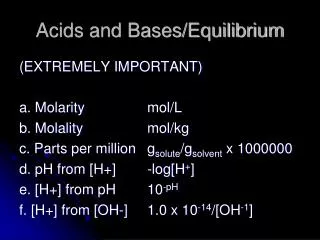
Acids and Bases/Equilibrium (EXTREMELY IMPORTANT) a. Molarity mol/L b. Molality mol/kg c. Parts per million gsolute/gsolvent x 1000000 d. pH from [H+] -log[H+] e. [H+] from pH 10-pH f. [H+] from [OH-] 1.0 x 10⁻¹⁴/[OH-1]
Acids and Bases/Equilibrium (ALSO EXTREMELY IMPORTANT) 2. What is the pH range of an acid? 0-7 What is the pH range of a base? 7-14 What is neutral? 7 3. The hydrogen ion (hydronium ion) concentration 4. The equivalence point needs to fall within the transition range of the indicator 5. #H+MacidVacid = #OH-MbaseVbase