Understanding Ancient Greece: Geography, Civilizations, and City-States
20 likes | 178 Vues
This review sheet explores the geography of Greece, detailing its location surrounded by seas and its mountainous terrain that shaped the lifestyle of its inhabitants. It compares the Minoan and Mycenaean civilizations, highlighting key differences and similarities. The impact of the Dark Age on Greek society is assessed through positives and negatives. Additionally, insight is provided into the concept of Greek city-states, including definitions of essential terms like Polis and Acropolis, while examining changes in citizenship from Ancient Greece to today.


Understanding Ancient Greece: Geography, Civilizations, and City-States
E N D
Presentation Transcript
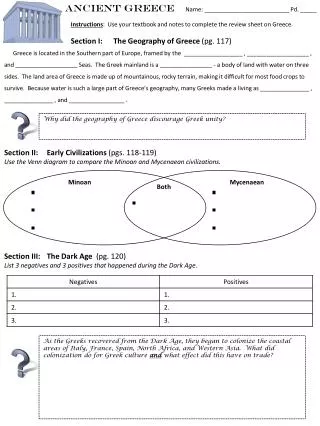
Ancient GreeceName: __________________________ Pd. _____ Instructions: Use your textbook and notes to complete the review sheet on Greece. Section I: The Geography of Greece (pg. 117) Greece is located in the Southern part of Europe, framed by the __________________ , ___________________ , and ___________________ Seas. The Greek mainland is a ________________ - a body of land with water on three sides. The land area of Greece is made up of mountainous, rocky terrain, making it difficult for most food crops to survive. Because water is such a large part of Greece’s geography, many Greeks made a living as _______________ , _______________ , and _________________ . Why did the geography of Greece discourage Greek unity? Section II: Early Civilizations(pgs. 118-119) Use the Venn diagram to compare the Minoan and Mycenaean civilizations. Minoan Mycenaean Both Section III: The Dark Age (pg. 120) List 3 negatives and 3 positives that happened during the Dark Age. As the Greeks recovered from the Dark Age, they began to colonize the coastal areas of Italy, France, Spain, North Africa, and Western Asia. What did colonization do for Greek culture and what effect did this have on trade?
Ancient Greece (cont.)Name: __________________________ Pd. _____ Section IV:City-Sates (pg. 122-130) Define the following terms. Polis - Acropolis - Agora - Hoplites - Read the section “What was Greek Citizenship?” on page 122. How is citizenship today different than it was in Ancient Greece?


![ANCIENT GREECE [Map 05-01]](https://cdn3.slideserve.com/5762335/slide1-dt.jpg)