Download
1 / 5
0 likes | 2 Vues
Take the next step in your DevOps journey with Visualpathu2019s SRE Training. Learn to automate, monitor, and manage systems effectively. Hands-on sessions with real-time projects enhance your practical learning. Certified trainers guide you toward global career recognition. For details and a free demo, call 91-7032290546.<br>Visit: https://www.visualpath.in/online-site-reliability-engineering-training.html<br>WhatsApp: https://wa.me/c/917032290546<br>Visit Our Blog: https://visualpathblogs.com/category/site-reliability-engineering/

E N D
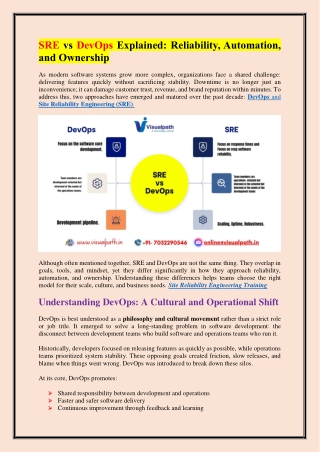
SRE vs DevOps Explained: Reliability, Automation, and Ownership As modern software systems grow more complex, organizations face a shared challenge: delivering features quickly without sacrificing stability. Downtime is no longer just an inconvenience; it can damage customer trust, revenue, and brand reputation within minutes. To address this, two approaches have emerged and matured over the past decade: DevOps and Site Reliability Engineering (SRE). Although often mentioned together, SRE and DevOps are not the same thing. They overlap in goals, tools, and mindset, yet they differ significantly in how they approach reliability, automation, and ownership. Understanding these differences helps teams choose the right model for their scale, culture, and business needs. Site Reliability Engineering Training Understanding DevOps: A Cultural and Operational Shift DevOps is best understood as a philosophy and cultural movement rather than a strict role or job title. It emerged to solve a long-standing problem in software development: the disconnect between development teams who build software and operations teams who run it. Historically, developers focused on releasing features as quickly as possible, while operations teams prioritized system stability. These opposing goals created friction, slow releases, and blame when things went wrong. DevOps was introduced to break down these silos. At its core, DevOps promotes: Shared responsibility between development and operations Faster and safer software delivery Continuous improvement through feedback and learning
Heavy use of automation to reduce manual effort and errors DevOps encourages teams to think of software as a living system, not a finished product. From planning and development to deployment and monitoring, the same team is involved throughout the lifecycle. SRE Course Importantly, DevOps does not prescribe exact rules. Each organization interprets and applies DevOps differently, based on its size, maturity, and goals. Understanding SRE: Engineering Reliability as a Discipline Site Reliability Engineering, or SRE, originated at Google as a way to apply software engineering principles to operations work. Instead of treating reliability as a vague goal, SRE defines it as something that can be measured, managed, and improved using data. SRE teams are usually made up of engineers with strong software backgrounds who focus specifically on keeping systems reliable, scalable, and efficient. Key ideas that define SRE include: Reliability as a feature that must be engineered Clear reliability targets tied to business needs Quantitative measurement of system health Automation as a requirement, not a preference Unlike DevOps, SRE is more prescriptive. It introduces concrete concepts such as service-level objectives, error budgets, and controlled risk-taking. These ideas help teams balance innovation with stability in a structured way. Site Reliability Engineering Online Training Reliability: Philosophy vs Measurement One of the biggest differences between DevOps and SRE lies in how they treat reliability. DevOps and Reliability In a DevOps environment, reliability is a shared responsibility. Teams aim to build systems that are stable, but reliability is often addressed through best practices such as monitoring, testing, and incident reviews rather than strict numerical targets. DevOps teams focus on: Preventing failures through automation and testing Responding quickly when issues occur Learning from incidents to improve future releases Reliability is important, but it is often guided by experience and judgment rather than formal metrics. SRE and Reliability
SRE treats reliability as something that must be explicitly defined and measured. Teams set clear expectations for system behavior and track whether those expectations are being met. Instead of aiming for perfection, SRE accepts that failures will happen. The goal is to control how often they happen and how much impact they have. This approach allows organizations to: Make informed decisions about risk Avoid over-engineering systems Align technical reliability with business priorities Reliability in SRE is not just an outcome; it is a discipline. Automation: Helpful Tool vs Mandatory Practice Automation plays a central role in both DevOps and SRE, but the expectations differ. Automation in DevOps In DevOps, automation is a powerful enabler. Teams automate tasks like deployments, testing, and infrastructure management to move faster and reduce errors. However, the level of automation can vary. Some DevOps teams still rely on manual steps, especially in smaller organizations or legacy environments. SRE Training Online Automation in DevOps is often driven by convenience and efficiency rather than strict rules. Automation in SRE In SRE, automation is non-negotiable. Manual work is seen as a risk to reliability and scalability. SRE teams actively reduce repetitive tasks and treat excessive manual intervention as a sign of technical debt. If a task must be done more than a few times, it is a candidate for automation. This mindset allows SRE teams to: Scale systems without increasing headcount Reduce human error during incidents Free engineers to focus on long-term improvements Automation in SRE is not just about speed; it is about sustainability. Ownership: Shared Responsibility vs Defined Accountability Ownership is another area where DevOps and SRE differ in practice. Ownership in DevOps
DevOps emphasizes collective ownership. The same team that builds a service is responsible for running it in production. SRE Courses Online This approach encourages: Better design decisions Faster feedback loops Stronger accountability for quality However, shared ownership can sometimes lead to confusion, especially in large organizations. When everyone owns reliability, it may be unclear who is responsible for improving it systematically. Ownership in SRE SRE introduces clear accountability for reliability. While development teams still own their code, SRE teams own the reliability strategy. This does not mean SRE takes control away from developers. Instead, SRE acts as a partner, setting reliability standards and helping teams meet them. This model works well at scale, where: Many teams depend on shared platforms Reliability risks can affect the entire organization Consistency is critical Ownership in SRE is explicit, measurable, and enforceable. Handling Risk and Change Both DevOps and SRE aim to move fast safely, but they approach risk differently. DevOps encourages frequent, small changes to reduce the impact of failures. The idea is that smaller changes are easier to understand, test, and roll back. SRE Certification Course SRE adds structure to this idea by defining how much risk is acceptable. Instead of arguing about whether a change is too risky, teams rely on agreed-upon thresholds. This approach helps reduce emotional decision-making and aligns engineering work with business goals. Team Structure and Roles DevOps is typically implemented within product teams. Engineers may take on hybrid roles, combining development, testing, deployment, and operational responsibilities. SRE teams are often centralized or embedded within larger organizations. They work across multiple services, bringing consistency and expertise in reliability engineering.
Neither structure is inherently better. The right choice depends on: Company size System complexity Regulatory requirements Growth stage When to Choose DevOps, SRE, or Both For many organizations, DevOps is the first step toward modern engineering practices. It helps break silos, improve collaboration, and accelerate delivery. Site Reliability Engineering Course As systems grow and reliability becomes mission-critical, SRE provides a more disciplined approach. Many mature organizations adopt both: DevOps principles guide culture and collaboration, while SRE provides the framework for reliability at scale. Rather than choosing one over the other, the most successful teams understand how they complement each other. Final Thoughts DevOps and SRE share a common goal: delivering value to users without compromising system stability. Their differences lie not in opposition, but in emphasis. DevOps focuses on culture, collaboration, and continuous improvement. SRE focuses on engineering reliability through measurement, automation, and clear ownership. Understanding these distinctions helps leaders and engineers build systems that are not only fast and flexible, but also dependable and resilient. In a world where downtime is costly and expectations are high, that balance matters more than ever. Visualpath is a leading online training platform offering expert-led courses in SRE, Cloud, DevOps, AI, and more. Gain hands-on skills with 100% placement support. Contact Call/WhatsApp: +91-7032290546 Visit: https://www.visualpath.in/online-site-reliability- engineering-training.html