Advanced Sensitivity Proposals for HAWC Arrays: A $6M to $300M Vision
This document outlines proposed upgrades to the HAWC detector arrays, aiming to improve sensitivity to gamma rays across a range of energies. The initial phase includes a $6M project for a compact 150m x 150m array with enhanced PMT grid sensitivity using precision simulations. Future expansions envision HAWC 300 and HAWC 1000, with capabilities significantly greater than the original HAWC detector. These enhancements propose increased detection at both low and high energies, aiming for 5-sigma detection flux levels and improved analysis techniques. Data comparisons include GLAST, VERITAS, and other gamma-ray detection arrays.

Advanced Sensitivity Proposals for HAWC Arrays: A $6M to $300M Vision
E N D
Presentation Transcript
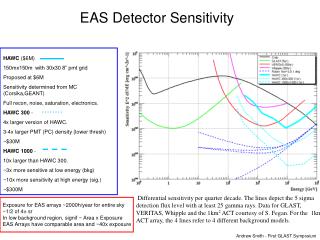
HAWC ($6M) 150mx150m with 30x30 8” pmt grid Proposed at $6M Sensitivity determined from MC (Corsika,GEANT) Full recon, noise, saturation, electronics. HAWC 300 - 4x larger version of HAWC. 3-4x larger PMT (PC) density (lower thresh) ~$30M HAWC 1000 - 10x larger than HAWC 300. ~3x more sensitive at low energy (bkg) ~10x more sensitivity at high energy (sig.) ~$300M Differential sensitivity per quarter decade. The lines depict the 5 sigma detection flux level with at least 25 gamma rays. Data for GLAST, VERITAS, Whipple and the 1km2 ACT courtesy of S. Fegan. For the 1km2 ACT array, the 4 lines refer to 4 different background models. EAS Detector Sensitivity Exposure for EAS arrays ~2000h/year for entire sky ~1/2 of 4 sr In low background region, signif ~ Area x Exposure EAS Arrays have comparable area and ~40x exposure Andrew Smith - First GLAST Symposium
10TeV gamma HAWC - /h Separation 10TeV proton “Shape cuts” for HAWC @~14TeV “Angle Reconstruction” for HAWC @~14TeV