Childhood Autism: Diagnosis, Management & Outcome
Understand the clinical picture and background factors of Childhood Autism, learn about assessment methods, and discover effective management strategies for parents. Explore the likely outcome and relevant factors affecting the condition.

Childhood Autism: Diagnosis, Management & Outcome
E N D
Presentation Transcript
Autistic Disorder Fatima AlHaidar Professor, Child & Adolescent Psychiatrist KSU
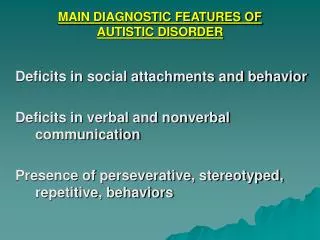
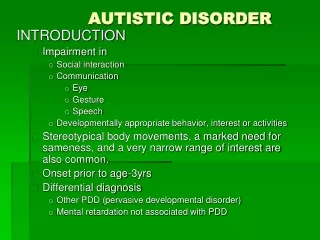
Childhood autism is one of the PDDs that is characterized by early onset (before 3 years of age) of delay and deviation in three critical areas of development : 1- the ability to form social relationships and to share interest and emotions. 2- the use of language and communication ( both verbal and non-verbal) . 3- the presence of severely incapacitating ritualistic tendencies . Definition:
ClinicalPicture : A. Behavioral Features, 1- social relationships. 2- speech and language development. 3- mannerisms. 4- resistance to change. 5- attachment to particular objects. 6- acute emotional reactions. 7- other behavioral symptoms.
ClinicalPicturecont. B. Intellectual development, 1- general intelligence. 2- specific deficit. 3- special abilities. C. Physical conditions
BackgroundFactors: 1- Overview. 2- Genetic factors. 3- Underlying physical conditions. 4- Parents and family factors. 5- Link with schizophrenia.
ASSESSMENT: 1- Overview. 2- Differential diagnoses ; 1- MR and learning disabilities. 2- Asperger’s disorder. 3- Childhood disintegrative disorder. 4- Rett’s disorder. 5- Language developmental disorders. 6- Childhood schizophrenia. 7- ADHD 8- Attachment disorders.
Management: # Explain to the parents the nature of the diagnosis and its probable cause and the way the child can be helped and the likely outcome. # Neither medications nor interpretive form of psychotherapy directed to the patient have a significant place in management. # Behavioral and educational methods have been shown to be helpful.
Managementcont. # Goals for treatment: 1- fostering of normal development; - parental counseling - behavioral methods - special schooling. 2- reduction of rigidity and stereotypy. 3- removal of maladaptive behavior. 4- alleviation of family distress.
Outcome A life-long condition; - 66% ---- total dependence. - 50% ---- linguistic impairment. - 10% ---- slight improvement. - <10% ----working. - 16% ----epilepsy. - 50%---- deterioration during adolescence. - 10% ---- psychiatric disturbance. Important factors relevant to outcome: - IQ - quality of parental care and education. - slow progress.