Download
1 / 16
160 likes | 270 Vues
Explore the fascinating world of stars, comets, and asteroids in our Milky Way galaxy. Learn the distinction between comets and asteroids, and discover how stars are formed from nebulae. Understand the impact of a star's size on its life cycle, ranging from becoming a red giant to possibly exploding as a supernova. Gain insight into the potential risks asteroids pose to Earth and the mesmerizing phenomenon of star formation. This knowledge will deepen your appreciation for the cosmos and the processes that govern it.

E N D
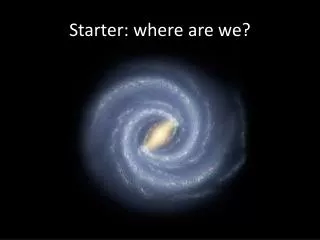
The sun is one of billions of stars in our galaxy, the Milky Way
Objectives • Learn the difference between a comet and an asteroid • Describe how stars are formed • Explain how the size of a star impacts the life cycle of a star
Comets and asteroids • Comets: have a frozen core of dust and gas. As they approach the sun the gases evaporate to form a tail making them easy to see • Asteroids: are a band of rock debris found between the orbits of Mars and Jupiter
The end... • Many small asteroids collide with Earth each year • Although the chances are small, it is predicted that an asteroid between 1-10km could hit the Earth within the next million years • This could create devastating tidal waves and so much dust could be released into the atmosphere that light is prevented from reaching the Earth
How I wonder what you are! Stars are all at different stages of their life cycles. They do not last forever. Some of the stars we see no longer exist!
Star formation • Clouds of dust and gas called nebula are pulled together by strong gravitational forces • This increases the temperature and nuclear reactions start taking place • Massive amounts of energy are released and forms a star • Eventually the hydrogen gas runs out and the star gets colder and expands • What happens next depends on the size of the star
Put these stages of star formation in the correct order • Massive amounts of energy are released and forms a star • What happens next depends on the size of the star • Eventually the hydrogen gas runs out and the star gets colder and expands • Clouds of dust and gas called nebula are pulled together by strong gravitational forces • This increases the temperature and nuclear reactions start taking place
Check the order • Clouds of dust and gas called nebula are pulled together by strong gravitational forces • This increases the temperature and nuclear reactions start taking place • Massive amounts of energy are released and forms a star • Eventually the hydrogen gas runs out and the star gets colder and expands • What happens next depends on the size of the star
What happens next?If the star is about the size as the sun • The star cools and becomes a red giant • It continues to cool and then collapses under its own gravity to become a white dwarf • Eventually it becomes a black giant
What happens next?If the star is about the size as the sun • Label the flow chart
What happens next?If the star is about the size as the sun • Check your labels Star Red giant White dwarf Black dwarf
What happens next?If the star is much bigger than the sun • The star cools and becomes a red supergiant • It shrinks rapidly and explodes releasing energy dust and gas into space called a supernova • This dust and gas (nebula) forms new stars and the remains of the supernova will either be a neutron star or a black hole
What happens next?If the star is much bigger than the sun • Label the flowchart
What happens next?If the star is much bigger than the sun • Check your labels Neutron star Supernova Star Red supergiant Black hole