Key Literature Terms: Understanding Fiction, Imagery, and Language Techniques
30 likes | 138 Vues
This guide explores essential literary terms, enhancing comprehension of fiction and writing nuances. Definitions include historical fiction as a story set around real events, the concept of credible characters appearing authentically, and anthropomorphism that attributes human traits to non-human entities. Discover techniques like foreshadowing and similes, which create vivid imagery and comparisons, while also learning about idioms that reflect cultural expressions. This resource aims to deepen your understanding of themes, figurative language, and text features essential for literary analysis.


Key Literature Terms: Understanding Fiction, Imagery, and Language Techniques
E N D
Presentation Transcript
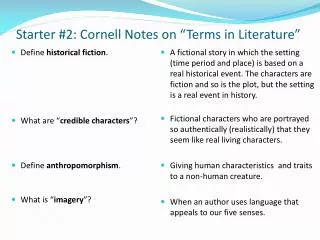
Starter #2: Cornell Notes on “Terms in Literature” • Define historical fiction. • What are “credible characters”? • Define anthropomorphism. • What is “imagery”? • A fictional story in which the setting (time period and place) is based on a real historical event. The characters are fiction and so is the plot, but the setting is a real event in history. • Fictional characters who are portrayed so authentically (realistically) that they seem like real living characters. • Giving human characteristics and traits to a non-human creature. • When an author uses language that appeals to our five senses.
Starter #2: Cornell Notes on “Terms in Literature” • Define foreshadowing. • What is a “simile”? Give examples. • Explain what is meant by the term“inference.” • What is an “idiom”? • When the author purposely drops clues that hint at what may happen. • A comparison using the word like or as: * The column of smoke was thickening and blackening like a shadowy tree. * The jars of Vesuvian wine were as fiery as the inside of a volcano. • Using clues from the story to figure out what the author does not tell you explicitly: It may be a prediction, or it may offers more information. • An expression or figure of speech that makes sense to people in a particular group or culture but would be confusing to others. [He “kicked the bucket.”]
Starter #2: Cornell Notes on “Terms in Literature” • What is “figurative language”? • What are “text features”? Give examples. • Explain what is meant by the term“theme” in literature. • An imaginative way to make comparisons between seemingly unlike things. Those expressions are not literally true: They are figures of speech. Anything in the text (printed material) that helps the reader gain better understanding—titles, sub-titles, illustrations (photos, artwork), captions, call-outs, sidebars, footnotes. • An insight about life or human nature that you gained after reading a story(a “lesson for life”)