Understanding Vectors and Scalars: Essential Concepts in Physics
Vectors and scalars are fundamental to physics, representing physical quantities. Vectors have both magnitude and direction, with examples including displacement, velocity, and acceleration. In contrast, scalars possess only magnitude, like distance, speed, time, and mass. This guide outlines how to represent vectors graphically, add and subtract them, and utilize trigonometric methods for resolution. Learn the properties of vector addition, how to calculate resultants, and the importance of component analysis in understanding vector relationships.

Understanding Vectors and Scalars: Essential Concepts in Physics
E N D
Presentation Transcript
Vectors An essential component of your physics toolbox.
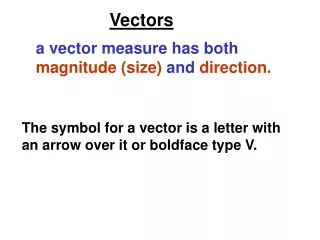
Vectors vs. Scalars • Vector: physical quantity that has both magnitude and direction • Examples: displacement, velocity, acceleration • Scalar: physical quantity that has magnitude but no direction • Examples: distance, speed, time, mass
Representing Vectors • Symbols in text • boldface • Symbols on paper/board • arrow above symbol • Graphically • draw an arrow • length represents magnitude • angle and head of arrow shows direction (angle) • label vector with quantity and/or value v1 = 3 m/s
Adding and Subtracting Vectors • Only vectors of the same quantity and units may be added or subtracted • You can’t add a velocity vector and a displacement vector • You can’t add a velocity in m/s with a velocity in mph • Resultant: vector that represents the sum of two or more vectors
Graphical Addition of Vectors • Draw all vectors to scale. • Add vectors using Head-To-Tail Method • Draw 1st vector • Begin tail of 2nd vector at head of 1st vector • Lather, rinse, repeat • Draw resultant vector from tail of 1st vector to head of last vector. Label resultant.
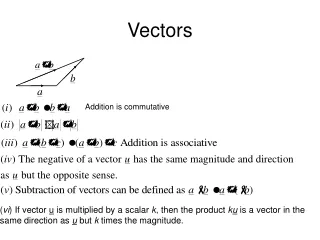
Properties of Vector Addition • Vectors can be moved parallel to themselves in a diagram. • Useful for switching from Head-To-Tail Method to Parallelogram Method • Vectors can be added in any order • Resultant will always be the same. • To subtract a vector, add its opposite. • Multiplying or dividing vectors by scalars results in vectors. • velocity (vector) = displacement (vector) / time (scalar) • accel (vector) = change in velocity (vector) / time (scalar)
Vector Components:Graphical Representation • projection of vector along x & y axes • how much in the x direction, how much in the y direction • drop projection lines to x & y axes • draw components along axes
Resultant of Two Non-90 Vectors • USE THE COMPONENT METHOD • Add x components • Add y components
Trigonometry Primer • Trigonometric functions relate measurements in right triangles. • Much of our work with vectors can be visualized with right triangles, so we need to know how to do trigonometry.
Trig Primer: Pythagorean Thm. • The Pythagorean Theorem relates the lengths of the sides of a right triangle. c b a
Trig Primer: SOH CAH TOA hyp opp θ adj
Vector Resolution:Finding Vector Components • Trigonometric Method • Visualize vector and its components as a right triangle • Apply Pythagorean Theorem & SOHCAHTOA to find components (“missing sides”)
Vector Addition:Finding a Resultant Vector • Magnitude: • Find the sum of all x-components and all y-components • Use Pythagorean Theorem to find resultant from components.
Vector Addition:Finding a Resultant Vector • Direction: • Apply inverse trig functions to find angle