Understanding Outgroups in Cladistic Tree Construction
Outgroups are essential for rooting phylogenetic trees, as they provide a frame of reference for the group under study. For an outgroup to be effective, it should be closely related yet outside the ingroup. By comparing shared character states, we can infer which traits are ancestral (plesiomorphic) versus derived (apomorphic). While constructing trees, character conflicts may arise, making it crucial to rely on the principle of parsimony for accuracy. This approach allows us to address homology and homoplasy, providing insight into evolutionary relationships.

Understanding Outgroups in Cladistic Tree Construction
E N D
Presentation Transcript
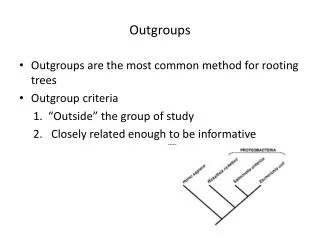
Outgroups • Outgroups are the most common method for rooting trees • Outgroup criteria 1. “Outside” the group of study • Closely related enough to be informative
Outgroup Rule: Character states shared by the outgroup and some of the ingroup are likely plesiomorphic
Build the tree with cladistics Characters Taxa 1 2 3 4 5 Outgroup 0 0 0 0 0 A 1 0 0 0 1 B 1 1 0 1 0 C 1 0 1 1 0
Fig. 26-UN5 Draw the tree using cladistics… 1 2 3 4 5 6
If character conflict occurs, pick the correct tree based on the principle of parsimony 10 variable binary characters, minimum number of steps = 10 12 changes Character 3 evolves twice Character 2 evolves once and is lost 11 changes Character 10 evolves once and is lost
Problems in tree building • Character conflict
Good synapomorphies • Homology = similarity in form or function shared by organisms because the feature was found in their common ancestor
Misleading Characters • Homoplasy = “false homology”
Which lineages are endotherms? The most parsimonious explanation is that endothermy arose twice: Convergence
Convergence in mammals (easier to ID for marsupials vs. placentals)—similar ecological niches Mammal tree article
DNA data (right) has turned conventional mammal taxonomy (left) on its head. Morphological analyses were mislead by convergence.
Mapping character state changes onto a tree 2 independent gains of echolocation (convergence) or 1 gain followed by one loss (character state reversal)? Which do you consider more likely?