DNA Structure and Function: Pioneers and Replication Process
Explore the experiments of DNA pioneers and learn about the basic structure and function of DNA. Discover how DNA replication occurs and the importance of base pairing rules.

DNA Structure and Function: Pioneers and Replication Process
E N D
Presentation Transcript
DNA Structure and Function
Learning Target • I can describe the experiments of major scientists in determining both the structure of DNA and the Central Dogma.
DNA Pioneers • Frederick Griffith, British scientist, 1928 • His guiding question was “How do certain bacteria cause pneumonia?” • Designed experiments to figure this out using mice and two slightly different strains of bacteria
Griffith’s Experiment • Griffith called the process of passing the disease causing trait to the harmless bacteria “ transformation”
DNA Pioneers • Oswald Avery, Canadian biologist, 1944 • Decided to repeat Griffith’s work • Made extract from heat killed bacteria; then treated this with enzymes that could destroy some molecules. Transformation still occurred. • Discovered that DNA stores and transmits genetic information from generation to generation
DNA Pioneers • Hershey-Chase • Two American scientists: Alfred Hershey and Martha Chase • Collaborated on studying viruses that infect living organisms • Bacteriophage: type of virus that infects bacteria
Hershey-Chase • http://highered.mcgraw-hill.com/olcweb/cgi/pluginpop.cgi?it=swf::535::535::/sites/dl/free/0072437316/120076/bio21.swf::Hershey%20and%20Chase%20Experiment
DNA Pioneers • Erwin Chargaff, American biochemist • Puzzled by relationship between DNA’s nucleotides • Discovered that guanine and cytosine are nearly equal in any DNA sample; same went for adenine and thymine
DNA Pioneers • Rosalind Franklin, • British scientist, 1952 • Studied DNA using xray diffraction • Recorded DNA pattern • Died of radiation cancer before she could have received Pulitzer Prize
Watson and Crick • James Watson, American biologist • Francis Crick, British physicist • Used Franklin’s xray diffraction (without her permission) to develop the double helix model of the structure of DNA
Learning Target • I can describe the basic structure and function of DNA.
DNA Structure Video • http://www.youtube.com/watch?v=sf0YXnAFBs8
Structure & Function of DNA • DNA is: • A complex polymer made of deoxyribonucleic acid • Nucleic Acids are made of nucleotides
Nucleotides • Are made of • A simple sugar (Deoxyribose) • A phosphate group • A nitrogen base
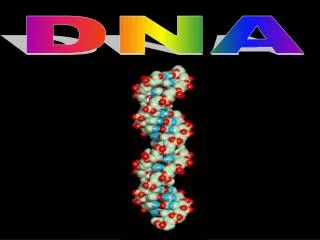
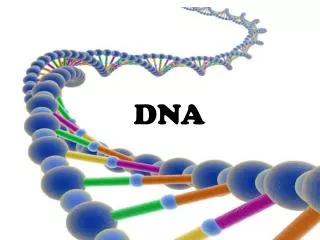
DNA Structure • Double Helix • Two strands twisted around each other • Resembles a winding staircase
DNA Structure • Each side of the double helix is made of alternating sugar (deoxyribose) and phosphates • Each strand is linked to the other by nitrogen bases
DNA Nitrogen Bases • Four nitrogen bases make up the “stairs” of the DNA double helix • Adenine • Guanine • Cytosine • Thymine
DNA Nitrogen Bases • Adenine and Guanine are purines • Made of two rings of carbon and nitrogen atoms • Cytosine and Thymine are pyrimidines • Made of one carbon and nitrogen ring
Base Pairing Rules • One Purine must pair with one Pyrimidine • The pairings are very specific; follow Chargaff’s Rules • Adenine and Thymine always pair • Cytosine and Guanine always pair • A and T form two hydrogen bonds • C and G form three hydrogen bonds
DNA Replication • The process of making a copy of DNA is called DNA replication • Remember that DNA replication occurs during the “S” phase of interphase prior to the cell entering mitosis or meiosis
DNA Replication • http://www.youtube.com/watch?v=zdDkiRw1PdU
DNA Replication • Replication is semi-conservative meaning that each new double helix consists of an old strand of DNA
DNA Replication—Step 1 • DNA helicases unwind double helix by breaking hydrogen bonds • Proteins attach to each strand to hold them apart and prevent them from twisting back • This area is called a replication fork
DNA Replication: Step 2 • Within the replication forks, DNA polymerase moves along each strand adding nucleotides to exposed nitrogen bases • These are added according to base pairing rules • As DNA polymerase moves along, two new double helices are formed
DNA Replication: Step 2 • The two strands are called the leading strand and the lagging strand. • New nucleotides are always added in the 5’ to 3’ direction • The leading strand goes very smoothly because it is in the 5’ to 3’ direction • The lagging strand goes from the 3’ to 5’ direction • So its nucleotides are placed in small sections called Okazaki fragments. These are placed in the 5’ to 3’ direction
DNA Replication: Step 3 • DNA polymerase remains attached until all the DNA is copied • It detaches once replication is complete • Two new DNA strands are made • Each new double helix contains a new strand and an old strand • The two new double helices are identical to each other.
DNA Replication: Step 4 • DNA polymerases can proofread and can back track a bit to correct any errors. • Only 1 error per 1 billion nucleotides.
Learning Target • I can describe the basic function and structure of mRNA, tRNA, amino acids and proteins. • I can use codon charts to determine amino acid sequences of example polypeptides.
DNA to RNA to Proteins • DNA, the genetic code, is made in the nucleus. • DNA carries the instructions for making proteins. • Proteins are made in ribosomes in the cytoplasm. • How does this happen? RNA
DNA to RNA to Proteins • RNA takes the genetic code from the nucleus to the ribosomes in a process called transcription. • RNA differs from DNA in 3 ways: • It is a single strand (alpha helix) • It contains the sugar ribose • It has a different nitrogen base: uracil • Uracil replaces thymine
RNA • Three types of RNA • mRNA-messenger RNA carries copies of protein instructions • rRNA-ribosomal RNA; on the ribosome • tRNA-transfer RNA; transfers each amino acid to the ribosome as specified by the genetic code
Transcription • Transcription begins when RNA polymerase binds to DNA and separates the DNA strand • RNA polymerase uses one strand of DNA as a template to make into one strand of RNA
Transcription • The RNA polymerase (an enzyme) finds the promotor region on the DNA. • Promotors signal where the enzyme should attach onto the DNA.
DNA Transcription • DNA must be copied to messenger RNA (mRNA) • mRNA goes from nucleus to the ribosomes in cytoplasm • mRNA complements known as codons • Only 3 nucleotide “letters” long • Remember RNA has uracil (U) instead of thymine (T)!
A C G T A T C G C G T A T G C A T A G C G C A T Transcription – Step I Template DNA Strands
A C G T A T C G C G T A U G C A U A G C G C A U Transcription – Step II Template DNA is Matched Up with Complementary mRNA Sequences
A C G U A U C G C G U A U G C A U A G C G C A U Transcription – Step III mRNA leaves nucleus and goes to ribosomes A new complementary RNA strand is made (rRNA)
RNA Editing • RNA needs to be edited. • DNA has sequences of DNA not necessary for making proteins. These are called introns. • The DNA sequences needed for transcription are called exons. • Both are copied but the introns are cut out before leaving the nucleus.
Transcription Reminders • The template strand is the DNA strand being copied • The rRNA strand is the same as the DNA strand except U’s have replaced T’s
Genetic Code • Different proteins have different functions • It is estimated that each human cell has more than 30,000 genes • Each gene is a code for making a specific protein
Genetic Code • Sequences of nitrogen bases give the code for making a specific protein • Proteins are made from 20 amino acids and DNA has only 4 nitrogen bases • How do these small numbers make up the thousands of combinations to make a protein?
Genetic Code • It takes sequences of three bases to provide the necessary combinations to make the proteins • Each set of three nitrogen bases is called a codon (or triplet code) • The order of nitrogen bases can determine the type and order of amino acids in a protein