Counting Ways to Represent 14 as Sums of 5 Nonnegative and Positive Integers
This problem explores the various ways in which the number 14 can be expressed as the sum of five nonnegative integers and the sum of five positive integers. Using combinatorial techniques, we can represent the number 14 with its components broken down into sums, employing formulas that count the arrangements of integers and separators. By transforming positive integers into nonnegative integers through a simple adjustment in the summation, we effectively utilize a mathematical approach to determine the total combinations possible.

Counting Ways to Represent 14 as Sums of 5 Nonnegative and Positive Integers
E N D
Presentation Transcript
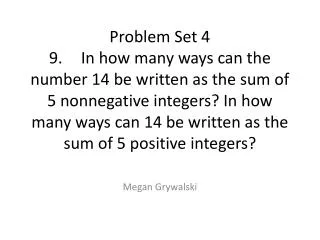
Problem Set 49. In how many ways can the number 14 be written as the sum of 5 nonnegative integers? In how many ways can 14 be written as the sum of 5 positive integers? Megan Grywalski
In how many ways can the number 14 be written as the sum of 5 nonnegative integers? • Think of each expression broken down into a sum of 1’s (i.e. 5+3+2+0+4=14 =11111+111+11++1111=14) To find the number of ways to arrange 14 1’s and 4 +’s we would use: =
Given an expression of nonnegative integers that sums to n, with m = number of integers you are adding and p=m-1 (p=+’s) we can use the formula to find the number of ways to sum m integers equal to n.
In how many ways can 14 be written as the sum of 5 positive integers? • If we have a+b+c+d+e= 14 where a, b, c, d, and e are positive integers, we can change this to a sum of nonnegative integers by subtracting 1 from each a-1+b-1+c-1+d-1+e-1=14-5 a-1+b-1+c-1+d-1+e-1=9 Now we can use the same formula: