Enhancing Reciprocal Knee Flexion and Extension in Stroked Individuals Through Prone Position Training
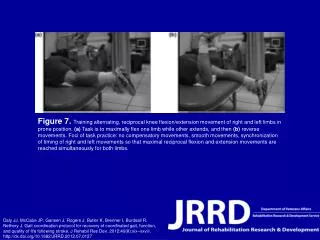
This training protocol focuses on improving the alternating, reciprocal movements of knee flexion and extension in both limbs while in a prone position. Participants flex one limb maximally while the opposite limb extends, then reverse the movement after reaching the peak of each motion. The key objectives are to avoid compensatory movements, promote smooth transitions, and synchronize the timing of movements to achieve optimal reciprocal actions in both limbs. This method aims to facilitate coordinated gait recovery and improve function and quality of life following a stroke.

Enhancing Reciprocal Knee Flexion and Extension in Stroked Individuals Through Prone Position Training
E N D
Presentation Transcript
Figure 7. Training alternating, reciprocal knee flexion/extension movement of right and left limbs in prone position. (a) Task is to maximally flex one limb while other extends, and then (b) reverse movements. Foci of task practice: no compensatory movements, smooth movements, synchronization of timing of right and left movements so that maximal reciprocal flexion and extension movements are reached simultaneously for both limbs. Daly JJ, McCabe JP, Gansen J, Rogers J, Butler K, Brenner I, Burdsall R, Nethery J. Gait coordination protocol for recovery of coordinated gait, function, and quality of life following stroke. J Rehabil Res Dev. 2012;49(8):xix–xxviii.http://dx.doi.org/10.1682/JRRD.2012.07.0127