Download
1 / 26
260 likes | 369 Vues
Explore essential concepts in cell biology, including the functions of organelles such as the nucleus, Golgi apparatus, and mitochondria. Discover the processes of photosynthesis and cellular respiration, alongside membrane dynamics like osmosis. Learn how cells replicate through mitosis and meiosis, the role of different energy molecules, and the significance of osmotic balance. This comprehensive guide enhances understanding of key biological processes vital for life.

E N D
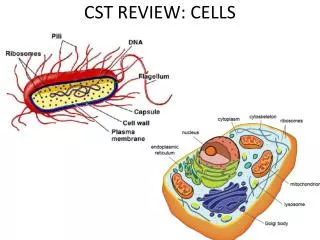
Organelles #1 What is the function of the nucleus? Answer: Store DNA and control the cell
Organelles #2 Which cell organelle packages proteins and sends them out of the cell? Answer: the Golgi Apparatus
Organelles #3 Which organelle modifies proteins and sends them through the cell? Answer: the Endoplasmic Reticulum
Organelles #4 Which organelles make proteins? and Where can you find them (2 places)? Answer: the ribosomes, attached to the rough ER or floating around the cell
Organelles #5 What is the function of the mitochondria? Answer: to supply chemical energy (ATP) to the cell
Photosynthesis #1 What does the first reaction in photosynthesis require? Answer: light energy (light-dependent reaction)
Photosynthesis #2 What is the product of photosynthesis? Answer: sugar (glucose)
Photosynthesis #3 Which organelle does photosynthesis? Answer: the Chloroplasts
Photosynthesis #4 Which type of cells can do photosynthesis? Answer: plant cells
Photosynthesis #5 What does a plant need to take in to do photosynthesis? Answer: carbon dioxide and water
Cellular Respiration #1 Which organelle gets energy for the cell? Answer: the Mitochondria
Cellular Respiration #2 What type of energy molecules does cellular respiration produce? Answer: ATP
Cellular Respiration #3 What type of sugar do mitochondria break down to make ATP? Answer: Glucose
Cellular Respiration #4 Does the Kreb’s Cycle require oxygen to happen? (Is it aerobic?) Answer: yes
Cellular Respiration #5 Which process happens when there is no oxygen in the cell? (Anaerobic) Answer: Fermentation
Osmosis and Membranes #1 The cell membrane allows small molecules, like water and oxygen, to pass through it. Other molecules are blocked. What is this type of membrane called? Answer: Semi-permeable
Osmosis and Membranes #2 Which type of macromolecule makes up membranes? Answer: Phospholipids (lipids)
Osmosis and Membranes #3 The process of water moving through a membrane to balance concentrations is called… Answer: Osmosis
Osmosis and Membranes #4 What would happen to a cell full of fresh water if we put it in salt water? Answer: the water would go out of the cell and the cell would shrink
Osmosis and Membranes #5 Which types of cells have membranes? Answer: Both plant and animal cells (plants also have cell walls)
Mitosis and Meiosis #1 Which process do cells go through to make an identical copy of themselves? Answer: mitosis
Mitosis and Meiosis #2 What do we call the daughter cells produced through meiosis? Answer: gametes or sex cells
Mitosis and Meiosis #3 What do we call cells that have a two copies of each chromosome? (46 in humans) Answer: diploid
Mitosis and Meiosis #4 How many chromosomes are there in a haploid human cell? Answer: 23
Mitosis and Meiosis #5 In mitosis and meiosis, how many times does the DNA replicate and how many times does the cell divide? Answer: Mitosis – replicates once, divides once Meiosis – replicates once, divides twice