Understanding the Dust Bowl and Its Impact on American Families
This lesson explores the profound effects of the Dust Bowl and the Great Depression on American society, particularly focusing on displaced families known as "Okies." Through John Steinbeck's poignant observations, we examine the ecological disaster that forced millions to migrate in search of work and sustenance. We will define key terms such as foreclosure and Hoovervilles, compare the experiences of tenant farmers and urban workers, and discuss how gender roles were challenged during this difficult period.

Understanding the Dust Bowl and Its Impact on American Families
E N D
Presentation Transcript
Section 10.2 The Dream Foreclosed
Today’s Agenda • 10.2 Slide Show • Presentations • Homework • Finish reading Chapter 10.2 & begin 10.3 • Quiz on Chapter 10 Thursday (40-50 points)
"And then the dispossessed were drawn west- from Kansas, Oklahoma, Texas, New Mexico; from Nevada and Arkansas, families, tribes, dusted out, tractored out. Car-loads, caravans, homeless and hungry; twenty thousand and fifty thousand and a hundred thousand and two hundred thousand. They streamed over the mountains, hungry and restless - restless as ants, scurrying to find work to do - to lift, to push, to pull, to pick, to cut - anything, any burden to bear, for food. The kids are hungry. We got no place to live. Like ants scurrying for work, for food, and most of all for land." - John Steinbeck, The Grapes of Wrath, 1939 • What is Steinbeck talking about?
ObjectivesAt the end of this lesson you should be able to: • Define and describe the Dust Bowl • Define foreclosure and Penny auction • Define Okie and list 3 characteristics of their life • Compare the effects of the Depression on tenant farmers with urban workers • Describe a Hooverville in a short paragraph • Describe how the role of fathers and mothers were affected by the Depression • Describe the impact of the Depression socially, physiologically and nutritionally
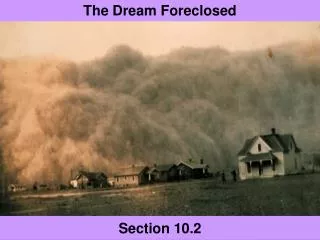
What was the Dust Bowl? • ecological and human disaster that took place in the southwestern Great Plains region (Oklahoma/Texas) 1933-1934 • Term coined because as the land dried up, great clouds of dust and sand, carried by the wind, covered everything • caused by • misuse of land • years of sustained drought • Millions of acres of farmland became useless • hundreds of thousands migrated to California
What happened to farms? • Overproduction + falling prices = inability for farmers to pay their mortgages • Banks foreclosed (repossessed) farms and auctioned them off • Penny Auction- collective effort of farmers to ‘buy’ foreclosed farms/equipment at low prices and return it to original owner
Who were the Okies? • Okie = migrating homeless Midwestern farmers (some from Oklahoma) of 1930s • Migrated mainly to California along Route 66. • 15% of the Oklahoma population left • Called the migrants "Okies", regardless of whether they were actually from Oklahoma • term was disrespectful and used in a derogatory manner, with connotations of homeless, poverty, hickishness • Lived outside of towns in Hoovervilles • Paid starvation wages for laborious farm labor
What happened to tenant farmers during the Depression? • Rented land that they farmed • To get prices to rise government encouraged farm owners to let some land lie fallow • Gave owners $ to buy better equipment • No longer needed farm laborers • Owners threw tenants off land
How were Mexican American treated during the Depression? • Discriminated against • More than 12 thousand (some US citizens) rounded up in 1931-34 and repatriated (sent back to Mexico)
What are Hoovervilles? • About 2 million homeless in ’32 • Constructed temporary shelters • Conditions varied • Some squalid, garbage/rat laden • Others humble but clean
How was the role of the father affected? • Traditionally the provider • Unemployment = lost status, self-esteem • No longer the breadwinner • Some sank into depression • Abandonment • Others sought work daily • Kept busy (see quote on page 341) • Painted house for 2 years
How was the role of mother affected? • Traditional role as homemaker bolstered • Depression less drastic effect • Controlled family budget and rationing • Domestic industries revived • Illegal for more than 1 member of family to work for gov. • 25% increase in female employment
What was the “Invisible Scar”? • Psychological fear of impending disaster • Tore some families apart • Ashamed, less social • Lack of hope • Marriage, children put off • Malnourishment common