Equilibrium Analysis of Demand and Supply Exercises
This document presents step-by-step solutions to two practice problems involving demand and supply equations. The first exercise analyzes the equilibrium price and quantity where demand is given by P = 40 - 2Q and supply is P = Q. The second exercise involves P = 30 - Q and P = 2Q. Each problem includes converting functions, solving equilibrium equations, calculating equilibrium price and quantity, and graphic representations of the market. It serves as a practical guide for understanding market equilibrium concepts.

Equilibrium Analysis of Demand and Supply Exercises
E N D
Presentation Transcript
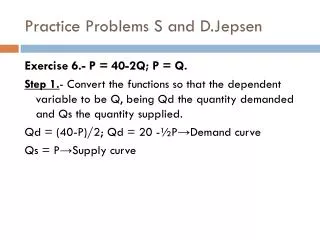
PracticeProblems S and D.Jepsen Exercise 6.- P = 40-2Q; P = Q. Step 1.- Convertthefunctions so thatthedependent variable tobe Q, beingQdthequantitydemanded and Qsthequantitysupplied. Qd = (40-P)/2; Qd = 20 -½P→Demand curve Qs = P→Supply curve
PracticeProblems S and D Jepsen Exercise 6.- P = 40-2Q; P = Q. Step 2.- Calculation of theequilibriumpricebysolvingtheequilibriumequation: Qd = Qs Substituting 20 -½P = P Solving 20 = P + ½P; 20 = 3P/2; P = 40/3 €
PracticeProblems S and D Jepsen Exercise 6.- P = 40-2Q; P = Q. Step 3.- Calculation of theequilibriumquantitybysubstituting P oneitherfunctions: Qd = 20 -½P = 20 – ½·40/3 = 13.33 units Qs = 13.33 units
PracticeProblems S and D Jepsen Exercise 6.- P = 40-2Q; P = Q. Step 4.- Graphicrepresentation of equilbriummarket. Demand and supplyschedule: Graph.- Wedrawthegraphontheboard.
PracticeProblems S and D.Jepsen Exercise 7.- P = 30-Q; P = 2Q. Step 1.- Convertthefunctions so thatthedependent variable tobe Q, beingQdthequantitydemanded and Qsthequantitysupplied. Qd = 30-P→Demand curve Qs = ½P→Supply curve
PracticeProblems S and D Jepsen Exercise 7.- P = 30-Q; P = 2Q. Step 2.- Calculation of theequilibriumpricebysolvingtheequilibriumequation: Qd = Qs Substituting 30-P = ½P Solving 30=3P/2; P = 30·2/3 =20 € Equilibriumprice: PE = 20 €
PracticeProblems S and D Jepsen Exercise 7.- P = 30-Q; P = 2Q. Step 3.- Calculation of theequilibriumquantitybysubstituting P oneitherfunctions: Qd = 30-P= 30-20= 10units Qs = ½·20 = 10 units
PracticeProblems S and D Jepsen Exercise 7.- P = 30-Q; P = 2Q. Step 4.- Graphicrepresentation of equilbriummarket. Demand and supplyschedule: Graph.- Wedrawthegraphontheboard.