
Logical Operations
E N D
Presentation Transcript
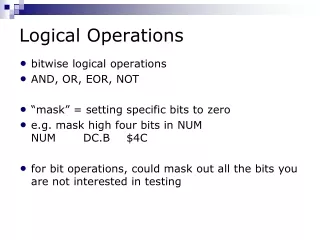
Logical Operations • Boy who sow wild oats better hope for crop failure. • Chinese Proverb
7 Logical Operations in MIPS x gets y’ x gets result of y,z operation • not x, y • and x, y, z • nand x, y, z • or x, y, z • nor x, y, z • xor x, y, z • xnor x, y, z
Mask and Merge Example • Macros can be useful to cut down on writing repetitive code blocks like print statements. • NewLine macro will print a linefeed to the console, called by newline • PHex will print an int in hex format, %value is a substitution string, in this case it should be a register. • E.g. PHex($t4)
Mask and Merge Example. • Mask using bitwise and will mask out bits, E.g. • 0x70707070 • Merge using bitwise or, sets bits. E.g • 0x7777FFFF • Note: the macro calls
Shifts • Move bits to new locations in a word • 3 Type of Shifts allowed • Logical shift • Arithmetic Shift • Rotate • Can shift right or left by a specified number of bits (0 - 31)
MAL’s Shift Operations • sll shift left logical • srl shift right logical • rol rotate left • ror rotate right • sra shift right arithmetic • Format • operation destination, source, Amount
Logical Shift (cont.) Logical shifts give us an alternate method of bit extraction (instead of masking). To extract bits p through q sll x, y, (31-q) srl x, x, (31-q+p) Example: Extract bits 16 through 23 sll x, y, (31-23) = sll x, y, 8 srl x, x, (31-23+16) = srl x, x, 24
Count # of 1’s in a word • Mask out all bits except the LSB, if it is a 1 count it. • Rotate right 1 bit and repeat
Partial Products • Partial products are added as they are generated
Standard Multiply Algorithm • Multiply can be done using a series of shift and add operations • product = 0 • while multiplier is non-zero • if multiplier LSB = 1 • product = product + multiplicand • multiplier = multiplier >> 1 • multiplicand = multiplicand << 1
Alternate Multiply Algorithmhow h/w does it. • 32 bit x 32 bit = 64 bit result • Multiplicand is added into Product_High, Multiplier loaded into Product low. Shift Product_High Product_Low B A Multiplicand Multiplier
Alternate Multiply Algorithmhow h/w does it • product_high = 0 • product_low = multiplier • do { • If (LSB of multiplier == 1) then • add multiplicand to product_High • shift multiplier (product_low) right 1 • shift product_high right 1 • } while (product has not been shifted 32 times) • Note: the shift will be done together as 1 cycle in h/w. • Broken down for clarity. • After 32 shifts, the multiplier will be moved out.
End Notes on Multiply • The algorithm loops 32 time • Product_low has been shifted 32 times • Product_high has been shifted 32 times • LSB become MSB of Product_low on shift • Rather than shift the multiplicand left and keeping the product stationary, we keep the multiplicand stationary and shift the product right. • Easier to build in h/w
Signed Multiplication • Same algorithm but with small adjustment • Save XOR of sign bits to get product sign bit • Convert multiplier & multiplicand to positive • Perform normal multiplication algorithm • Negate result if product sign bit is 1
Unsigned Division Algorithm • remainder = dividend • quotient = 0 • for i=1 to # of significant digits • divisor = divisor >> 1 • quotient = quotient <<1 • if divisor <= remainder • remainder = remainder - divisor • quotient = quotient +1
Unsigned Division • 01000010 --Dividend = 66 • 00000110 --Divisor = 6 • Determine # of significant digits in quotient, shift divisor left until shifted divisor is > dividend • 01000010 --dividend • 01100000 --Shifted divisor
Division Determine number of significant bits in quotient
Alternate Division Algorithmhow h/w does it Low High Shift • Initialize High to 0 and Low to the Dividend. Remainder Dividend +/- Quotient Divisor
Alternate Division Algorithmhow h/w does it • High = 0 • Low = Dividend • { shift left • High = High – divisor • If High < 0 • High = High + divisor • Else • Low = Low or 0x01 • } (While not shifted 32 times) • Note: Low OR 0x01 will set the LSB of Low, same as adding a 1 since the shift left would shift in a 0.